







Seu próximo nível começa aqui
Seu desenvolvimento não pode ter limites. Garanta sua Assinatura Ilimitada e libere uma preparação completa com os melhores professores do Brasil.
Text 1
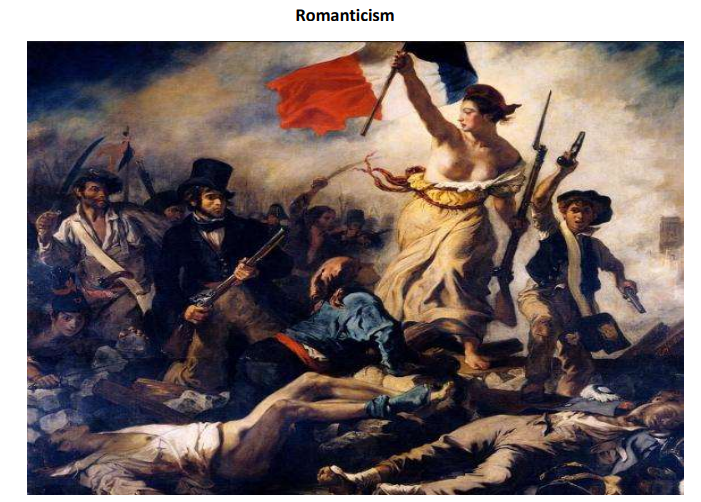
Liberty Leading the People, oil on canvas by Eugène Delacroix, 1830.
1. Romanticism, attitude or intellectual orientation that characterized many works of literature, painting, music, architecture, criticism, and historiography in Western civilization over a period from the late 18th to the mid19th century. Romanticism can be seen as a rejection of the precepts of order, calm, harmony, balance, idealization, and rationality that typified Classicism in general and late 18th-century Neoclassicism in particular. It was also to some extent a reaction against the Enlightenment and against 18th-century rationalism and physical materialism in general. Romanticism emphasized the individual, the subjective, the irrational, the imaginative, the personal, the spontaneous, the emotional, the visionary, and the transcendental.
2. A discussion of the key events and personalities of the late 18th- and early 19th-century Romantic movement in literature, music, and art. It contains dialogue based on letters and documents of the period.
3. Among the characteristic attitudes of Romanticism were the following: a deepened exaltation appreciation of the beauties of nature; a general of emotion over reason and of the senses over intellect; a turning in upon the self and a heightened examination of human personality and its moods and mental potentialities; a preoccupation with the genius, the hero, and the exceptional figure in general and a focus on his or her passions and inner struggles; a new view of the artist as a supremely individual creator, whose creative spirit is more important than strict adherence to formal rules and traditional procedures; an emphasis upon imagination as a gateway to transcendent experience and spiritual truth; an obsessive interest in folk culture, national and ethnic cultural origins, and the medieval era; and a predilection for the exotic, the remote, the mysterious, the weird, the occult, the monstrous, the diseased, and even the satanic.
BRITANNICA, The Editors of Encyclopaedia. “Romanticism”. Encyclopedia Britannica, 26 Dec. 2023, https://www.britannica.com/art/Romanticism. Accessed 1 February 2024
Analyze the sentences of text 1:
I. “Romanticism emphasized the individual, the subjective, the irrational, the imaginative, the personal, the spontaneous, the emotional, the visionary, and the transcendental”.
II. “A discussion of the key events and personalities of the late 18th- and early 19th-century Romantic movement in literature, music, and art. It contains dialogue based on letters and documents of the period”.
III.”Among the characteristic attitudes of Romanticism were the following: a deepened appreciation of the beauties of nature; a general exaltation of emotion over reason and of the senses over intellect”.