







Seu próximo nível começa aqui
Com a Assinatura Ilimitada, você tem tudo que precisa para sua aprovação.
Com a Assinatura Ilimitada, você combina prática, teoria e método em uma única assinatura com tudo que você precisa para sua aprovação.
the longest in "on the longest tributary" (l.2) is the opposite of the:
shortest;
widest;
largest;
broadest;
deepest.
According to the text, plastic bags should be:
used;
manufactured;
burnt;
avoided;
sold.
The opposite of "bottom" in "the reservoir's bottom" (l.27) is:
side;
depth;
height;
top;
margin.
The underlined word in "The downside is that" (l. 27) indicates an aspect which is
desirable;
negative;
favourable;
incredible;
pleasing.
A palavra sublinhada em "and quickly led" (l.3) pode ser traduzida por:
The underlined expression in "as well as individual members" (l. 7) marks an:
opposition;
evaluation;
anticipation;
exclusion;
addition
In the text, "Their reasoning is that learning the patterns correctly is easier than having to break old habits and learn new ones" (L.14-16) could be correctly replaced by
They believe that new items are learned only if old ones are corrected.
The teacher's reasoning is that the students' old habits are easily corrected.
These teachers' reasoning is that learning the patterns correctly is less difficult than having to stop old habits and learn new ones.
Teachers believe that breaking the students' old habits is easier than learning new ones.
at once;
so far;
for good;
little by little;
at least.
A palavra que preenche corretamente a lacuna indicada no texto é
stable.
declining.
worsening.
improving.
dropping.
"it", in "which it usually is" (L.30), refers to gasohol.
The word that can best replace "fence" in "Plant a bamboo fence" (l.11) is:
forest;
tree;
hedge;
garden;
hut.
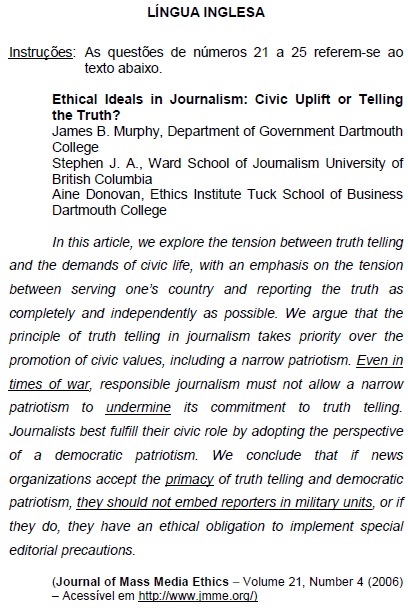
No texto, Even in times of war significa
Sempre que houver guerra.
Em qualquer época de guerra.
Em caso de guerra.
Mesmo em época de guerra.
No tempo da guerra.
A few in "a few of which are" (l. 14) means:
some;
others;
less;
most;
any.
Nevertheless in "Nevertheless, the designation" (l. 22) introduces a(n):
emphasis;
contrast;
summary;
exemplification;
generalization.
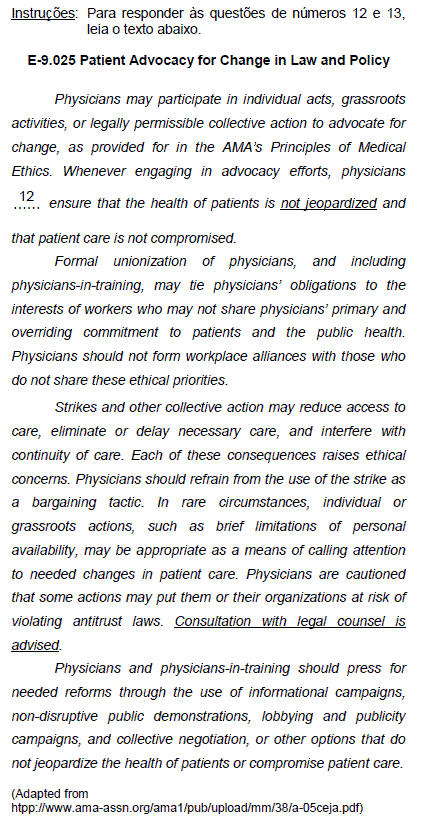
A palavra que preenche a lacuna corretamente é
can.
must.
may.
might.
could.
Instruções: As questões de números 16 a 20 referem-se ao texto apresentado abaixo.
Atenção: Para responder as questões de números 16 e 17 escolha, dentre as cinco alternativas, aquela que, apropriadamente, completa a oração levando em conta o texto como um todo.
Malnutrition is directly responsible for 300,000 deaths per year in children younger than 5 years in developing countries and contributes indirectly to over half the deaths in childhood worldwide.
The adverse effects of malnutrition include physical and developmental manifestations. Poor weight gain and slowing of linear growth occur. Impairment of immunologic functions in these (16) mimics those observed in children with AIDS, predisposing them to opportunistic and other typical childhood infections. Children who are chronically malnourished exhibit behavioral changes, including irritability, apathy and decreased social responsiveness, anxiety, and attention deficits. In addition, infants and young children who have malnutrition frequently demonstrate developmental delay or permanent cognitive deficits. The degree of delay and deficit depends on the severity and duration of nutritional compromise and the age at which malnutrition occurs. In general, nutritional insults at younger ages will have worse outcomes. (17) death from malnutrition in the United States is rare, in developing countries, more than 50% of the 10 million deaths each year are either directly or indirectly secondary to malnutrition in children younger than 5 years.
Children are most vulnerable to the effects of malnutrition in infancy and early childhood. Premature infants have special nutritional needs that are not met with traditional feeding recommendations; they require fortified human milk or specially designed preterm formula until later in infancy. Children are susceptible to malnutrition for differing reasons. During adolescence, self-imposed dietary restrictions contribute to the incidence of nutritional deficiencies.
(Adapted from http://www.emedicine.com/PED/topic1360.htm)
effects.
manifestations.
countries.
children.
deaths.
The definite article “the” (R.5) was used before “river” because it refers specifically to that same river mentioned on line 2.



