




Seu próximo nível começa aqui
Com a Assinatura Ilimitada, você tem tudo que precisa para sua aprovação.
Com a Assinatura Ilimitada, você combina prática, teoria e método em uma única assinatura com tudo que você precisa para sua aprovação.
Complete the sentence below with the correct conjunction. Choose the CORRECT answer.
“He didn’t fall asleep quickly _________ being extremely tired.”
although
though
however
in spite of
Consider the statements about the sentence below:
“the most beautifully organised drawers.” (l.17-18).
I. The noun is after the adjective.
II. There are two adjectives incorrectly ordered.
III. There are two adverbs.
Which ones are INCORRECT?
Only I.
Only II.
Only III.
Only II and III.
I, II and III.
Adverbs can modify adjectives, but an adjective cannot modify an adverb. Therefore, like adjectives, adverbs can have:
Ability to move around in a compound prepositional phrase.
Comparative and superlative forms to show degree.
Similar adverbial phrases of manner.
Verb or plural form between the auxiliary and the main verb.
There are five common terms (adverbs or prepositions) normally used when expressing or telling the time, in English, which are, among the following:
morning, afternoon, evening, noon and dusk.
hour, glass, clock, number and time.
before, after, now, together and separate.
o'clock, past, quarter, half past and to.
season, summer, fall, spring and winter.
Complete the sentence below with the correct word. Choose the CORRECT answer.
“_________ is used to show that the noun, pronoun, etc has or owns something”
Genitive Case
Adverb
Adjective
Modal
Teacher can use this board to teach lessons about:
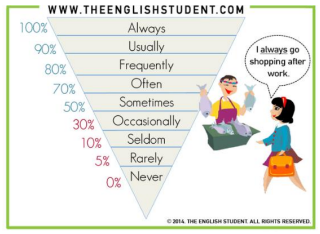
Adjectives
Degrees
Geometry
Adverbs
Simple presente tense
Complete the sentence below with the correct conjunction. Choose the CORRECT answer.
“We visited many places in New York _________ it was raining a lot.”
Complete the sentence below with the correct conjunction. Choose the CORRECT answer.
“I could speak in front of everyone_________
being very nervous.”
and
although
despite
while
during
In English, there are lots of subordinating conjunctions, but the most common ones, introduces a dependent clause and ties it to an independent clause. Choose the only alternative with Subordinating Conjunctions:
No sooner, than rather, than.
For, and, nor, but, or, yet, so.
Both, and, not only, but also.
After, although, as, as if, as long as.
“It is widely accepted that the learning process is instrumental in shaping one’s personality and the way he/she deals with situations of life.” (l. 1-2). In this sentence, the underlined conjunction that introduces:
a coordinate clause
an adjective clause
an adverb clause
a noun clause
In the fragment “Thus, whereas the man in the street” (line 43), the underlined adverb means “as a result of what has just been said or stated” and can be replaced with hence.
“Though” can be classified as:
A subordinating conjunction.
A conjunctive adverb.
A coordinating conjunction.
A linking adverb.
Complete the sentences with the correct conjunctions:
I. Tell me _______ we can meet.
II. Margie went home _______ she was tired.
how / where
where / because
when / where
because / when
because / where
Consider the statements about the word ‘yet’ (l.30):
I. It could be replaced by ‘so far’.
II. It is classified as an adverb.
III. It could be removed without affecting the meaning.
Which ones are correct?
Only I.
Only II.
Only III.
Only I and II.
I, II and III.
Complete the following sentences with the appropriate adjective or adverb to make the correct comparisons or superlatives.
I. Sam runs ________ (slow) than Leo.
II. This was the _______ (bad) ice-cream I have ever tasted.
III. Cycling is ________ (exciting) than running.
slow / worsest / more exciting
slower / worst / more exciting
slower / worse / exciting
slowest / worse / the more exciting
the slowest than / worse / more exciting
Considering adverbs ordering, choose the CORRECT alternative:
Can you repair now my watch?
Let’s go early to bed.
She sang very well last night.
He works on tuesday in the garage.
No enunciado "Moreover, Melor (2007) pointed out that social interaction technologies have great benefits for lifelong education environments", o termo "Moreover" funciona como uma conjunção:
adversativa
disjuntiva
aditiva
conclusiva
Read this excerpt from one of the previous texts:
“We must highlight all the positive, life-transforming rewards that have been the outcome of collective efforts to change our society, especially education, so that it is not a site for the enactment of domination in any form.”
Without changing the meaning, it is correct to substitute the conjunction so that in the clause above for:
in order to, without transforming the sentence in any other way.
in order to, but the sentence must be transformed to accommodate it.
so as to, because they’re synonyms and there’s no need for any other change in the sentence.
however, because both expressions imply a contrast of ideas.
then, because both expressions focus on the sequence of events.
The aviator was not to remain confined to the cockpit, however," What does the underlined term express in the text?
Result.
Addition.
Contrast.
Sequence.
Consequence.
The alternative that there is an adverb is:
Ovo vegetarians: Eat no meat, poultry, fish, or milk, but do eat eggs and dairy products.
Vegans (total vegetarians): Do not eat meat, poultry, fish, or any products derived from animals, including eggs and gelatin.
Partial vegetarians: Avoid meat but may eat fish (pescovegetarian, pescatarian) or poultry (pollo-vegetarian).
Lacto-ovo vegetarians do not eat meat, poultry, or fish, but usually do eat eggs and/or milk.