




Seu próximo nível começa aqui
Com a Assinatura Ilimitada, você tem tudo que precisa para sua aprovação.
Com a Assinatura Ilimitada, você combina prática, teoria e método em uma única assinatura com tudo que você precisa para sua aprovação.
A sintaxe da língua inglesa é predominantemente rígida, seguindo a ordem Sujeito-Verbo-Objeto, mas permite inversões e estruturas específicas para enfatizar informações. Registre V, para as afirmativas verdadeiras, e F, para as falsas:
( ) A inversão entre sujeito e auxiliar é obrigatória após advérbios ou expressões de sentido negativo ou restritivo, como "seldom" ou "under no circumstances", quando posicionados no início da frase.
( ) As orações clivadas (cleft sentences) iniciadas por "It" ou "What" servem para focalizar um elemento específico da sentença, deslocando a carga de informação para o início da estrutura frasal.
( ) Em orações exclamativas iniciadas por "Here" ou "There", ocorre a inversão sujeito-verbo obrigatoriamente se o sujeito for um pronome pessoal, para manter a ênfase rítmica do registro coloquial.
( ) A ordem direta dos adjetivos que antecedem um substantivo deve priorizar a opinião subjetiva antes de características físicas objetivas, como tamanho, idade, cor e origem.
Após análise, assinale a alternativa que apresenta a sequência CORRETA dos itens acima, de cima para baixo:
F, F, V, V.
V, F, F, V.
V, V, V, F.
V, V, F, V.
F, V, V, F.
Assinale a alternativa em que a frase está corretamente estruturada de acordo com a norma padrão da língua inglesa.
She don’t understand the instructions.
They has completed the activity earlier today.
By the time the guests arrived, we had already had dinner.
He study English every afternoon after school.
The teacher explain the lesson very clearly.
Identify the sentence that CORRECTLY employs the structures of gradual comparison or parallel increase to describe a proportional relationship between two evolving situations.
The more renewable energy sources are integrated into the power grid, the less dependent a nation becomes on fossil fuels.
As much as a city grows larger, it becomes more and more harder to manage its public transportation infrastructure efficiently.
The most the population increases, the biggest the demand for natural resources will eventually become.
More the technology advances, more the privacy concerns among internet users are likely to intensify.
The higher the interest rates rise, the least likely consumers are to spend money on high-value luxury goods.
Considering text 11A1-IV, which presents a famous Dr. Seuss quote, choose the correct option regarding the grammatical class of the words “know” and “go”.
“know” is a verb and “go” is a preposition.
“know” is an adverb and “go” is a verb.
Both “know” and “go” are verbs.
Both “know” and “go” are adjectives.
“know” is a noun and “go” is a verb.
No trecho: “This relentless barrage of interruptions and switching between thoughts and technology platforms is leaving us utterly exhausted." Marque a alternativa que identifica corretamente a classe gramatical da palavra utterly.
Artigo definido, pois acompanha o adjetivo.
Substantivo, pois nomeia o estado de exaustão.
Adjetivo, pois caracteriza o substantivo exhausted.
Advérbio, pois intensifica o sentido do adjetivo exhausted.
Choose the alternative with the correct grammar structure.
That car is her’s.
This seat is mine.
Is this pen your?
Those shoes are theys?
These are him keys.
Considering the grammatical rules that govern English verb tenses, it is correct to state that the highlighted verb forms in the excerpt below express:
“This expedition has been the favourite dream of my early years. I have read with ardour the accounts of the various voyages which have been made in the prospect of arriving at the North Pacific Ocean through the seas which surround the pole.”
states and experiential actions initiated in the past that remain valid or relevant at the moment of enunciation, with no explicit temporal delimitation, which is prototypical of the Present Perfect.
actions anterior to a secondary reference point situated in the past, establishing a temporal hierarchy that characterizes the Past Perfect by means of implicit retrospection.
durative and iterative actions whose semantic focus lies on habituality and general truth, approximating the aspectual value of the Simple Present, despite the auxiliary construction.
prospective meanings derived from the speaker’s accumulated experience, projecting completion prior to a future reference point and aligning with the Future Perfect reading.
a sequence of past states and actions temporally bounded within a closed interval, whose relevance is restricted to a completed phase of the speaker’s life, thus configuring a Present Perfect interpretation.
The internal structure of an adverb phrase allows for pre-modification and post-modification, usually to express degree or intensity. Analyze the following statements regarding the constituents of an adverbial phrase:
I. An adverb phrase can be modified by another adverb, as in "quite remarkably," where "quite" functions as a pre-modifier.
II. Post-modification in an adverb phrase is extremely rare but can occur with the adverb "enough," as in "well enough."
III. Adverb phrases function exclusively as adjuncts and can never perform the role of a subject complement in an English sentence.
Which of the following are CORRECT:
I and III only.
II and III only.
I and II only.
I, II, and III.
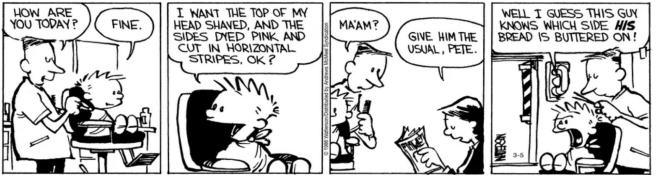
Available at: https://www.gocomics.com/calvinandhobbes/2026/03/05
In the last panel of the comic strip, the barber says: “Well, I guess this guy knows which side his bread is buttered on!”. Grammatically, the word “his” is a:
personal pronoun.
demonstrative pronoun.
reflexive pronoun.
possessive adjective.
relative pronoun.
Na gramática inglesa, os adjetivos são invariáveis em gênero e número, e, quando posicionados antes de um substantivo (função atributiva), devem seguir uma ordem específica de prioridade (ex: opinião, tamanho, idade, cor).
Certo
Errado
In English grammar, nominal agreement involves the correct relationship between nouns and the words that modify them, especially adjectives, demonstratives, and quantifiers. A solid understanding of nominal agreement is essential for accurate academic and professional communication. Analyze the alternatives below carefully and identify the sentence in which nominal agreement is correctly employed according to standard English grammar.
The expensive books on the central table belong to the university library.
The informations presented during the lecture were extremely relevant for the students
Those scientific equipments were inspected before the engineering experiment began.
These researches about environmental policies contains important statistical results.
In applying Larsen-Freeman’s 3D approach to teaching a specific grammatical structure like the passive voice, the pedagogical sequence that best illustrates the integration of Form, Meaning, and Use while addressing the Challenge Principle is
focusing exclusively on the accuracy of the form by providing a series of mechanical transformation drills, requiring students to change active sentences into passive ones to ensure the be + past participle pattern becomes a habit.
ensuring students can construct the morphosyntax (auxiliary be + past participle), explaining the semantic focus (defocusing the agent), and then implementing a context-sensitive task where students must choose between active and passive based on whether the agent is known or new information.
defining the structure as a static area of declarative knowledge by providing a list of verbs and their past participles for memorization, assuming that knowing the ‘how’ of the rules is sufficient for communication.
adopting a non-interface position by providing abundant comprehensible input through reading passages and assuming that students will pick up the complex rules of passive use naturally without any explicit focus on form.
treating the passive voice as a fixed set of rules with only one right answer and then testing students on their ability to identify the structure in isolated sentences without considering the social or discourse context.
Subject−verb agreement in English requires the verb to match the subject in person and number, especially in the third person singular of the simple present. With regard to the rules of subject−verb agreement, select the CORRECT alternative.
Agreement in noun phrases requires that the adjective receives a plural suffix "-s" whenever the noun it modifies is in the plural form to avoid syntactic fragmentation.
The verb "to be" is the only verb in English that has three different forms in the present tense to agree with all persons, except for the second person plural which uses "is."
In the simple present, most verbs take an "-s" suffix when the subject is "he," "she," or "it," or a singular noun, except for modal verbs which remain invariable.
Collective nouns such as "family" or "team" must always take a plural verb in American English, regardless of whether the speaker sees the group as a single unit.
"If an interaction is intentionally shielded from a partner’s view, the threshold of trust has likely been breached." This sentence structure focuses on:
A hypothetical past that cannot be changed (Third Conditional).
A cause-and-effect relationship in a real or very probable scenario (First/Zero Conditional).
A wish about the future that is unlikely to happen.
A regret concerning the current digital architecture of social media.
Relative clauses are parts of a sentence that provide more information about a noun. They are introduced by
Adjectives.
Adverbs.
Conjunctions.
Possessive cases.
Relative pronouns.
In academic discourse, cohesion plays a crucial role in structuring logical relationships between ideas, particularly in argumentative writing. Among the excerpts below one of them best demonstrates the use of concessive and referential cohesive devices that are typically employed to build contrast and support claims in argumentative texts. The appropriate option is:
“part of the problem is that teaching is often portrayed as something that’s too magical and cryptic to decode.”
“but despite this, there’s been little systematic research into how we can measure the personal characteristics that make a teacher effective – and how we can reliably select people for teacher training.”
“a recent study by Dr Allison Atteberry from the University of Colorado followed more than 3,000 teachers over the first five years of their careers, measuring their effectiveness by looking at student outcomes.”
“the debate over what makes a good teacher isn’t new – as far back as 500BC, Confucius was portrayed as a model teacher.”
Examine the phrase "2 medium sized finger limes... sliced lengthwise and the pearl like fruit removed." Which analysis correctly explains the passive voice construction and its grammatical implications in this context?
The phrase contains two active voice constructions where "sliced" and "removed" function as action verbs performed by the finger limes themselves.
The phrase demonstrates comparative adjectives "sliced" and "removed" that describe the physical characteristics of the finger limes in relation to other fruits.
This construction shows two present perfect tense verbs with the auxiliary "have" implied, indicating actions that started in the past and continue to the present.
This represents a reduced passive voice construction where the auxiliary verb "are" and the agent performing the actions have been omitted, with "sliced" and "removed" functioning as past participles.
The words "sliced" and "removed" are simple past tense verbs indicating completed actions that occurred before the recipe was written.
In the sentence “ESA is working on better debris removal,” the word “better” functions as
a noun.
a verb.
a superlative adjective.
a comparative adjective.
a conjunction.
Based on the text, analyze the following statements.
I. The text defends the idea that, since English is widely spoken, learning other languages is generally needless for native English-speaking professionals, especially lawyers or aspiring ones.
II. In “A recent Guardian survey revealed that 39% of young native English speakers were put off learning a foreign language because ‘most people speak English’ [...]”, the term “put off” means the same as “encouraged”.
III. In “She encourages students to learn a new language in their spare time”, the expression “spare time” refers to the period when a person is not engaged in obligatory activities, such as formal studies or work.
IV. In “[…] having foreign language skills can help to set you apart”, the expression “to set you apart” suggests distinction or differentiation in a competitive environment.
Mark the alternative in which the statements are correct.
I and II, only.
II and III, only.
III and IV, only.
I and IV, only.
I, II, III and IV.
Examine the morphological structure of compound words and derived terms in this recipe segment: "medium-sized," "pearl-like," and "buttermilk." Which analysis correctly categorizes these formations and their grammatical functions?
"Medium-sized" is a compound adjective, "pearl-like" is a simile construction using a comparative suffix, and "buttermilk" is a compound noun functioning as an ingredient name.
All three are hyphenated compound adjectives formed by combining two independent words to create descriptive terms that modify nouns.
"Medium-sized" uses a past participle formation, "pearl-like" demonstrates metaphorical language, and "buttermilk" is a simple noun with descriptive prefix.
"Medium-sized" is a compound adjective with participial structure, "pearl-like" is a compound adjective using the suffix "-like" for comparison, and "buttermilk" is a compound noun formed by combining two nouns.
All three represent compound verbs that have been converted into adjectival forms through the process of grammatical transformation.