







Seu próximo nível começa aqui
Com a Assinatura Ilimitada, você tem tudo que precisa para sua aprovação.
Com a Assinatura Ilimitada, você combina prática, teoria e método em uma única assinatura com tudo que você precisa para sua aprovação.
Mark the alternative that has the correct meaning for the phrasal verb “Give Up”:
find unexpectedly.
get upset.
stop trying.
start to fly.
take care.
Which option completes the paragraph below correctly?
Speak, FIDO!
Imagine you're out for a walk with your family when a strange dog approaches. The dog isn't aggressive, but it seems _________ something because it nudges you with its snout, and barks. What you don't know is that this dog is trained _______ a person with a medical condition. Around the corner, the dog's owner has collapsed, and the dog instinctively runs off ______ help. That's you! But how can the dog make you _______ what's wrong?
(Adapted from hitps:/Avww. timeforkids.com)
to want / help / to find / to understand
want / helping / finding / understanding
want / help / find / to understand
to want /
wanting / to helping / finding / understand
The sentence “Do you really mean that?” taken from the comic strip, express:
A question in the simple present tense.
A surprise in the present progressive tense.
A doubt in the past tense.
A hypothesis in the future tense.
Mark the option that best completes the gap in the text with the right form of the verb in brackets.
wins
has won
was winning
is winning
won
The word "their", in "[ ... ] with limited views of both the amplitude of the labour market and their own potenlial." (paragraph 6), refers to:
working class kids.
complex lives.
career aspirations.
students.
results from PISA.
Assinale a alternativa que contém uma frase no futuro.
You are late for the conference.
I found your puppy that was lost.
I'm going to travel next month.
I hope you get well.
A lot of common verbs have irregular simple past forms. In this sense, choose the right alternative that presents the irregular simple past form of the verbs: know, bring, begin, and do, respectively.
known, bringed, begin, was/were.
knew, bringed, began, did.
knowing, bringing, beginning, doing.
knew, brought, began, did.
known, brought, begun, done.
Assinale a alternativa que corretamente preenche a lacuna abaixo:
“Peter decided ________ Australia from south to north.”
Crossing.
To cross.
Cross.
Crosses.
Which one from the underlined verbs in the text conveys a different verb tense?
has
handed
decided
knew
got
Read the text and answer questions 31 and 32.
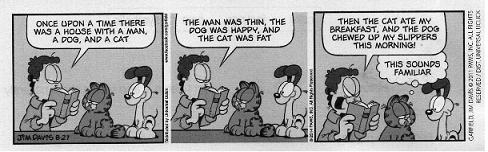
Adapted from http://www.englishact.com.br/2016/10/atividades-comtirinhas- do-garfield-em.html
What is the main verb tense used in the comic strip?
Present Perfect
Simple Present
Past Perfect
Simple Past
Choose the best option to complete the sentences:
1. So he won't give me my money back, _____?
2. You're not going to study, _____?
3. I don't think anyone will go, _____?
4. Everything is fine, ______?
will he – aren't you – will they – isn't it.
won’t he – are you – will they – is it.
will he – are you – won't they – isn't it.
won’t he - aren’t you – won't they – is it.
All answers are incorrect.
Read the text and answer question 42.
Dance Monkey
Tones And I
I‟ve never seen anybody do the things you do before
They say
Move for me, move for me, move for me, ay-ay-ay
And when you‟re done I‟ll make you do it all again
I said: Oh my God, I see you walking by
Take my hands, my dear, and look me in my eyes
Just like a monkey, I‟ve been dancing my whole life
And you just beg to see me dance just one more time
Ooh, I see you, see you, see you every time
Adapted from: https://www.letras.mus.br/tones-and-i/dance-monkey
The sentences underlined, in the text, are in the:
Present Perfect, Imperative, and Simple Present.
Present Perfect, Simple Present, and Imperative.
Simple Present, Imperative, and Present Perfect.
Simple Present, Present Perfect, and Imperative.
In the sentence: "Sofia took some pictures of splendid feathery clouds", the word feathery is:
An adverb that means "tenderness".
A verb that means "soft".
An adjective that means "clear, shiny".
An Adective that means "soft, delicate".
An adverb that means "impermanent".
Mark the option that best describes the phrasal verb “wind down” taken from the text:
It means one has to finish doing something.
It means one has to put something in order.
It means one has to relax.
It means one has to sleep.
It means one has to do something quickly.
If Katy....... thirsty, she`d have asked some water.
had been
were
has
will be
is
The verb “aided”, in bold in the text, is closest in meaning to:
Cured
Helped
Fought
Rescued
Choose the correct option to complete the paragraph below.
The Brazilian Navy ___ its new Antarctic station "Estação Antártica Comandante Ferraz" (EACF) on 15 January. The facility ___ by China National Electronic lmports and Exports Corporation (CEIEC) to replace the original EACF, which ___ by a tire in 2012. The new station ___ of laboratories, communications and meteorological modules, power generation equipment, and a living area for 64, as well as medical, healthcare, catering, and technical areas.
(Adapted from https://www.janes.com)
was inaugurated / built / destroyed / composes
inaugurated / was built / destroyed / composes
was inaugurated / built / destroyed / is composed
inaugurates / builds / was destroyed / was composed
inaugurated / was built / was destroyed / is composed
Read the dialogue below.
John: "I am about to fall asleep. I need to stay awake!"
Katie: "I _______ you some coffee."
Complete the dialogue with the right option.
“II go
'm going get
"ll get
'm go getto
“Il to go to get
Choose the alternative in which you can find the Past Perfect Continuous.
About 30 people had been staying on cots inside.
We were laying in bed when I heard sirens.
More than 50 roads have been closed.
Schools were opened for evacuees.
Analise as tabelas abaixo:
TABELA 1
I | Water boils at 100°C. |
II | Mary heard the sound of a bell. |
III | I will drive the car tomorrow. |
TABELA 2
A | Passado |
B | Presente |
C | Futuro |
Assinale a alternativa que relaciona a frase da “Tabela 1” ao tempo verbal correto da “Tabela 2”:
I–A; II–C; III–B.
I–C; II–A; III–B.
I–C; II–B; III–A.
I–B; II–A; III–C.



