







Seu próximo nível começa aqui
Seu desenvolvimento não pode ter limites. Garanta sua Assinatura Ilimitada e libere uma preparação completa com os melhores professores do Brasil.

Questions from 36 to 40 will be based on Text 04.
Text 04
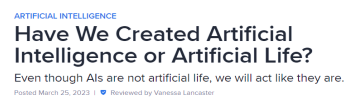
We have all been reading and hearing a lot about artificial intelligence (AI) recently because
it is an absolute game-changer. As AI developers madly rush forward to develop and deploy AIs,
we are reminded of the frenzied early days of the internet. AIs will soon be appearing everywhere
in every form imaginable. We are on the front end of a civilization-altering technology that will forever
5 change the way we work, play, learn, educate, think, govern, socialize, fight, and even love.
AIs are different than any other invention or technology in human history. Many previous inventions
and technologies, from the printing press to social media, have allowed us to communicate with
one another more easily and efficiently to broader and/or more distant audiences. Unlike such
technologies, AIs can communicate with us directly on their own. With their large language learning
10 algorithms and huge data sets, AIs such as ChatGPT can make it feel like we are interacting with
another person. We might debate the nuances here, but for all practical purposes, current AIs have
passed the fabled Turing Test (i.e., AIs can fool humans that they are interacting with a fellow
human rather than a computer).
Sure, ChatGPT requires prompts from us and does not “speak,” but this is only because it
15 was designed this way and has some technical limitations to overcome. While ChatGPT is
considered a “narrow AI” and has not yet reached what is considered “artificial general intelligence,”
it is already impressively smart at many tasks. As but one example, ChatGPT 4.0 can ace many
standardized tests, including the prestigious and notoriously difficult bar exam (impressively, at the
90th percentile).
20 We must remember that ChatGPT is merely the Atari 2600 of AIs. Thus, it is an entry-level
AI. The PlayStation 5 versions are on the way and will keep evolving. If Moore’s Law holds up
regarding how computing power increases, in 20 years, AIs will likely be about 1000 times more
powerful than ChatGPT 4.0.
25 Let this sink in for a moment: Human beings have created an intelligence that either rivals
us or far surpasses us in many capacities already. AIs can be designed to act autonomously, and
soon they will be able to grow and learn in real-time from their experiences and even interact with
other AIs. AIs will be able to create (give birth to?) other AIs. This sounds like the stuff of science
fiction, but AIs are capable of these things now or soon will be. We have reached an inflection point
in our human evolution, and our world will never be the same.
Adapted from: https://www.psychologytoday.com/us/blog/tech-happy-life/202303/have-we-created-artificial-intelligence-or-artificial-life , accessed on July 18th, 2023.
The question in the title of the article “Have we created Artificial Intelligence ou Artificial Life?” is in: