




Seu próximo nível começa aqui
Com a Assinatura Ilimitada, você tem tudo que precisa para sua aprovação.
Com a Assinatura Ilimitada, você combina prática, teoria e método em uma única assinatura com tudo que você precisa para sua aprovação.
Look at the comic strip below:
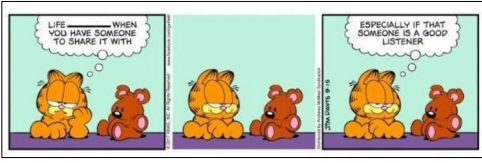
(Available on: https://militares.estrategia.com/. Accessed on: may 2025.)
According to the grammar rule, the alternative that contains the correct form of the adjective “easy” and explains its use is:
“Easyer”, because the comparative form is built by simply adding “er”to the adjective.
“More easy”, because “more” is used before short adjectives to form the comparative.
"Most easy”, because “most” is used to express the comparative of adjectives ending in “y”.
“Easier”, because when a short adjective ends in “y”, the “y” changes to “i” and “-er” is added to form the comparative.
Assinale a alternativa em que o adjetivo está aplicado corretamente na frase em inglês:
She has a car red.
They live in a beautiful house.
He is a man very strong.
I have a blue eyes.
Which adjectives below, when in their superlative form, follow the same spelling rules as the words in bold “driest” (I. 01), “poorest” (Il. 07), and “biggest” (I. 13)?
annoying - hot — far
happy - cool — sad
beautiful — hasty — slow
dangerous - shinny - quick
funny — good -— gloomy
Mark the alternative that, correctly and respectively, fills the dashed gaps in line 16 with the superlative form of the adjectives “late” and “great”:
later – best
latest – greatest
lately – most great
most late – greater
more late – better
Read the following dictionary definitions of the adjective iconic, and select the one that matches the author’s understanding of the word:
“relating to or characteristic of a famous person or thing that represents something of importance”.
“widely considered to epitomize an era, culture, community, place etc.”.
“being a famous person or thing that people admire and see as a symbol of a particular idea, way of life”.
“widely known and acknowledged especially for distinctive excellence”.
“showing a relationship between the form of a sign, such as a word or a symbol, and its meaning”.
Analyze the sentence below, which compares three different types of vehicles:
"Among hybrid cars, electric cars, and diesel cars, the electric option is often considered ______, while diesel cars are perceived as ______ when it comes to maintenance."
Which choice correctly fills in the blanks using comparative and superlative adjectives?
more efficient / the most complex
the most efficient / more complex
most efficient / the complexer
efficientest / most complex
the most efficient / the most complex
Select the adjective form that best completes the sentence.
This street is ______ than the one we walked on yesterday.
more narrow
narrowest
narrower
most narrow
very narrow
In the text, the word “terrifying” (second sentence of the first paragraph) conveys a sense of intense fear and is an adjective formed from the verb to terrify.
Certo
Errado
Adverbs are used to modify verbs, adjectives, or other adverbs, providing information about how, when, or where something happens. Analyze the statements about adverbs:
I."Yesterday" is an adverb of time that indicates when an action took place.
II."Quickly" is typically an adverb of manner, formed by adding "-ly" to the adjective "quick", describing how an action is performed.
III."Always" and "never" are adverbs of place that indicate where the action happens.
The correct statement(s) is/are:
I, II and III.
III, only.
II and III, only.
I, only.
I and II, only.
Adjectives are used to describe nouns, and their forms change when comparing two or more things. Analyze the statements about the degrees of adjectives:
I.To compare two things using short adjectives like "tall", we add "-er" to the end (e.g., "taller") and use "than".
II.To express the highest degree of a quality with long adjectives like "expensive", we use "the most" before the adjective.
III.The comparative form of the irregular adjective "good" is "gooder" and the superlative is "the goodest".
The correct statement(s) is/are:
I and II, only.
III, only.
I, II and III.
II and III, only.
I, only.
In the fifth paragraph, the adjective “rapid” could be replaced by quickly.
Certo
Errado
In the second paragraph, the text describes the physical appearance of the traditional witch as an "old, haggard woman." Considering the semantic field of physical description and the context of "alienation" and "ugliness," the term "haggard" is best defined as describing someone who looks:
Extremely fierce, aggressive, and ready to attack.
Exhausted, gaunt, and unwell, especially from fatigue or suffering.
Overweight, round, and physically imposing.
Mysteriously attractive despite their advanced age.
Disfigured by a specific magical accident or curse.
Choose the correct statement considering the underlined adjectives in the text and their correct degrees according to the context:
Drill Sergeant Mendonça barked orders to the Signal Corps students like a mad dog. Today's training was (demanding) than yesterday's, pushing the will-be NCO’s to their limits. The Signal Corps students are sure they are the (smart) bunch in academic disciplines, but they also needed to excel in their physical training. Mendonça, (mean) as a rattlesnake, kept reminding them of the consequences of failing the fitness test.
The obstacle course was the (bad) of all the exercises. They climbed walls, slogged through mud, and crawled under barbed wire, sweating like pigs. By lunchtime, they were exhausted and (hungry) than wolves. Sergeant Mendonça, however, would not let us rest. "This is not a picnic, gentlemen!" he yelled. The NCO academy is not for the faint of heart in fact, but the students are determined to make it.
The correct form of “smart” is “the most smart”.
“The worse” is the right form for “bad”.
“Demanding” becomes “most demanding” in the context.
“Hungryer” is the correct form for “hungry”.
The correct form of the adjective “mean” is “as mean”.
Choose the alternative that adjective(s) and sentence best define(s) how characters are represented in Americanah’s review:
Ifemelu is a gentle woman who works hard but doesn’t achieve any of her goals.
The smart and self-effacing Obinze was not afraid of taking illegal jobs in London.
The well-raised and well-fed Ifemelu represents a new kind of immigrant: the satisfied one.
Obinze is not as intelligent as Ifemelu.
The adjective “comfortable” in “ensure a more comfortable experience” is in the superlative form.
Certo
Errado
About superlatives and comparatives adjectives, mark the statements below as TRUE (T) or FALSE (F).
( ) “Least” and “worst” are the irregular superlative forms of “little” and “bad”, respectively.
( ) “Busyer” is the comparative form of the adjective “busy”.
( ) In the sentence “This is the smallest room in the building”, there is a superlative adjective.
The statements are, respectively:
F – T – F.
F – T – T.
F – F – T.
T – F – T.
T – F – F.
Read the sentence from the text:
"This stands out compared to other regions across Western Eurasia, where many changes were linked to substantial movement of people."
Match each highlighted word to its correct grammatical category:
COLUMN 1
I. This
II. other
III. where
IV. many
V. substantial
COLUMN 2
1.Relative adverb
2.Adjective
3.Quantifier adjective
4.Demonstrative pronoun
5.Attributive adjective
The correct matching is:
I-2, II-4, III-1, IV-5, V-3
I-4, II-2, III-1, IV-3, V-5
I-1, II-3, III-5, IV-2, V-4
I-3, II-2, III-5, IV-4, V-1
Which of the following grammatical categories are present in the syntactic construction With implacable and weary gaze, from beneath unmoving lids that seem carven of purple-veined onyx (/
I. Nouns: gaze, lids, onyx.
Il. Past participle: carven (archaic/poetic past participle of carve).
III. Adjectives: implacable, weary, unmoving, purple-veined,
I, II & III.
II & III.
III.
I & II.
Considere as afirmações sobre o emprego de adjetivos e advérbios na construção de sentidos em Inglês:
I. Adjetivos qualificam substantivos e podem alterar o significado do termo descrito, impactando o sentido global da frase.
II. Advérbios modificam verbos, adjetivos ou outros advérbios, contribuindo para nuances de tempo, modo ou grau.
III. A posição de um advérbio em uma frase não gera variações de sentido, pois sua função é fixa.
IV. A seleção de adjetivos e advérbios adequados pode ampliar a clareza e a eficácia comunicativa no texto.
Estão CORRETAS as afirmativas:
I e III, apenas.
II e III, apenas.
I, II e IV, apenas.
I, II e III, apenas.
Considering the phrase "SoftBank Robotics' latest machines sport smoother motions, improved speech recognition, and context-aware gestures," which analysis correctly identifies the adjective classifications?
"Context-aware" is a compound adjective; "latest," "smoother," and "improved" are descriptive adjectives in attributive position.
"Latest" is a superlative adjective in attributive position; "smoother" is comparative in predicative position.
"Latest" is an ordinal adjective; "smoother" is an adverb modifying "motions."
All adjectives function as predicative complements following the linking verb "sport."
"Latest" is a temporal adjective; "smoother" and "improved" are past participles functioning as adjectives.