



Questões de Concurso sobre Língua Inglesa e Educação


Disciplina 1
Assunto 1
Banca
Instituição
Cargo
Ano
Carreira
Área de formação
Escolaridade
Dificuldade
 
Comentários:
Professores
Alunos
Meus Comentários
Vídeo
 
Minhas questões:
Resolvidas
Não resolvidas
Certas
Erradas
 
Tipo de questão:
Certo e errado
Múltipla escolha
Incluir questões:
Anuladas
Desatualizadas
 
Questões:
Todas as questões
 
Filtro simplificado
 
Questões
Todas as questões
 
2.494 questões encontradas
Questões por página
20
Mais recentes
 

Write (1) for examples of oral practice activities, (2) for listening comprehension activities, (3) for reading activities and (4) for writing practice activities.
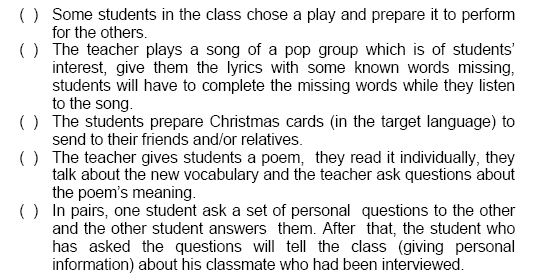

Imagem associada para resolução da questão

The correct sequence is:


A

2, 3, 1, 1, 4.


B

2, 4, 1, 3, 2.


C

1, 2, 4, 3, 1.


D

4, 2, 1, 2, 3.

Evaluation has to be seen as a process practice. The teacher has to pay attention to each student's learning development in every class, not only on exams and tests. This mode of evaluating is called:


A
Objective evaluation.

B
Diagnostic evaluation

C
Pedagogical evaluation.

D
Whole evaluation.

Besides the learning strategies discussed in the former question, learning a foreign language also develops important aspects of students' personality. The aspect which has nothing to do with students' personality is:


A
Self-confidence

B
Deduction

C
Affective control.

D
Self-esteem.

According to David Nunan (1999) a natural teacher is:


A

Someone who has some fluency in English but has not received much "formal training".


B

Someone who was born with the skills needed to be a teacher.


C

Someone who is involved with educational matters since the early years of his/her life.


D

Someone who has received professional preparation and higher education on teaching.

The following are examples of basic reading strategies:


A

Finding reading material that is at the reader's level, making a strong effort to read with perfect pronunciation, and planning how to read the text.


B

Integrating reading and writing, using of extensive reading and analyzing the information acquired.


C

Reading simplified texts, finding similar words in the text, making comparisons and remembering words.


D

Planning how to read a text, monitoring to see how reading is going, checking to see how much the text was understood, and making ongoing summaries.

 
Ir para a página:
OK
 
Gerar simulado