




Seu próximo nível começa aqui
Com a Assinatura Ilimitada, você tem tudo que precisa para sua aprovação.
Com a Assinatura Ilimitada, você combina prática, teoria e método em uma única assinatura com tudo que você precisa para sua aprovação.
At the age of forty, Joaquim Maria Machado de Assis invented a narrative device that transformed him from a provincial, rather conventional writer into a world-class novelist. This leap is usually explained biographically, and psychologically. Critics like to say that Machado, who nearly went blind, lost his illusions and passed from romanticism to realism — and so on. Explanations of this sort, however, are beside the point, since anyone can contract an illness, shed illusions or accept a new literary doctrine without becoming a great writer. But if we consider the change as one of literary form, the terms of the argument alter. Machado’s innovation then appears as an aesthetic solution to objective problems, lodged not simply within his own earlier fiction, but in the development of the Brazilian novel and indeed of Brazilian culture at large: perhaps even of ex-colonial societies in general.
In 1880 Machado published The Posthumous Memoirs of Brás Cubas, the first world-class Brazilian novel. What had changed with this novel? Its stroke of genius was to move the narrative point of view to the upper-class position. Hitherto, the narrators in Machado’s novels had always sympathized with those in a precarious, socially dependent situation, fretting over the arbitrary and unreliable behaviour of those who called the shots, as if to ask how such dependents could persuade their overlords to behave in a civilized manner, to make society more just and liveable for all. In other words, Machado’s unreliable narrator has a distinctly nineteenth-century class substance, and as a device this is its secret.
SCHWARZ, R. A Brazilian Breakthrough. In: New Left Review. 36, nov./dec., 2005. p. 91- 107 (adapted).
O texto apresenta um elemento inovador fundamental da ficção de Machado de Assis, que refere-se ao (à)
passagem de sua obra do movimento romântico para o realismo.
emprego de aspectos biográficos na composição de suas personagens.
transformação de temáticas provincianas em mundiais em seus romances.
aprofundamento das características psicológicas de suas personagens realistas.
mudança da focalização para personagens representantes da classe alta brasileira.
It is time now to return to the “literature” in “comparative literature” and to examine its position, which we believe vital, in the new digital context, which has become the context of all cultural production today. The fact that any form of production whatsoever is now impacted and transformed by the digital turn in culture, however, does not imply that literature and the book have become residual domains of culture, whose dominant and emergent forms (to follow here the terminology coined by Raymond Williams 1977) would then be digital and multimedia.
One may have the impression that literature is now evolving towards new forms of transmedia storytelling. True, this is a decisive turn or shift in contemporary writing. However, it would be dangerous to conclude that this evolution is linear or teleological. In this case, there is no reason at all to think that the literature of tomorrow will become transmedia storytelling, with only a marginal place left for what used to be considered literature and its traditional mediations. Even Henry Jenkins made it clear from the beginning that “not all stories will flow across media”, right after pointing to Hollywood´s pitches as the referential scenario against which transmedial storytelling’s focus on characters and worlds must be understood.
BAETENS, J.; SÁNCHEZ-MESA, D. Comparative Literature in the Age of Convergence Culture. Interfaces. 36, 2015 (adapted).
O texto apresentado faz uma reflexão sobre o lugar da literatura nos dias atuais, apontando para a
necessidade de comparação entre repositórios literários diferentes.
adaptação das narrativas literárias para plataformas digitais e multimídias.
emergência de novas formas de narrativas no novo contexto transmidiático.
complexidade da posição da literatura na relação entre os meios tradicionais e digitais.
mudança na produção de textos literários diante dos desafios contemporâneos.
Which expression is usually used to tell stories in English?
There was a house with a man
Then the cat ate my breakfast
That sounds familiar
Once upon a time
The plot of pure and tragic love of Shakespeare’s first great tragedy is known all over the world. This work is called
Hamlet.
Romeo and Juliet.
A Comedy of Errors.
Jane Eyre.
Vanity Fair.
A Christmas Carol (1843) is the story of a bad character who improves his behaviour after a ghost tells him how he will die. It was written by
Charles Dickens.
William Shakespeare.
Emily Bronte.
Charlote Bronte.
James Joyce.
The famous poem, The Raven (1845), depicts an unhappy young man who asks if he will again meet his dead loved one, Lenore. “Nevermore!” is the repeated, machine-like answer of the big black bird. This poem was written by
Ernest Hemingway.
T.S. Elliot.
Edgar Allan Poe.
William Shakespeare.
Oscar Wilde.
According to Kumaravadivelu (2001), “The postmethod learner is an autonomous learner. The literature on learner autonomy has so far provided two interrelated aspects of autonomy: academic autonomy and social autonomy”. Choose the alternative that corresponds to the author’s idea of autonomy:
Students should not be encouraged to organize their learning based on aspects that are considered myths by neuroscience, such as learning styles. Autonomy goes beyond the concept of identifying how we can learn better.
Standardized tests have been discredited by the concept of autonomy. Students ought to be led to discuss their own realities, focusing on problems they face in their own communities. Therefore, these tests go against the idea of autonomy defended by Kumaravadivelu.
Students should avoid their teachers’ interventions. Autonomy is a process that needs to be encouraged by activities focused on the development of self-learning.
According to the author of ‘The post method…’, social autonomy is mostly intrapersonal, which is why students who acquire it tend to make better decisions about their learning strategies, thus being able to help their peers.
Learners can be encouraged to reflect on their learning styles and strategies in order to achieve autonomy. Moreover, they can incorporate styles and strategies used by successful learners as a complement to their own learning process.
______, play by the Irish poet and writer Oscar Wilde (1854-1900), was first staged in London in 1895.
The Picture of Dorian Gray
De Profundis
The Soul of Man Under Socialism
The Importance of Being Earnest
It is possible to affirm that text A
tries to create a nightmarish setting.
focus on a dream, following Freud’s budding theories at the time.
shows the surprise of the narrator upon dealing with Heathcliff’s superstitions.
has elements of Gothic fiction.
Nobel Prize of Literature in 1954, American author and journalist Ernest Hemingway (1899-1961), published in 1940 a novel with the Spanish Civil War as its background. This work was called
For Whom The Bells Toll.
True at the First Light.
The Old Man and the Sea.
A Farewell to Arms.
Since Shakespeare and Dickens are “literary”, Anne Frank’s Diary of a Young Girl can be classified as
I. factual, because it recounts actual facts of her life. II. instructive, because it was written to alert the world against the dangers of Nazism. III. a mass media text, because it has become widely read and influential. There are, for instance, movies based on her diary. The correct assertion(s) is(are)I, only.
II, only.
II and III, only.
I and III, only.
Emily Brontë, author of Wuthering Heights, was sister to Charlotte and Anne Brontë, both also writers. Charlotte (1816-1855) was the first to achieve public recognition, publishing under the pen name “Currer Bell” a novel called
Frankenstein.
The Tenant of Wildfell Hall.
Jane Eyre.
Pride and Prejudice.
Member of the Bloomsbury Group, this author and publisher is today regarded as one of the most important modernist literary figures of the last century.
Virginia Woolf.
Ernest Hemingway.
T. S. Eliot.
James Joyce.
Read these very famous passages below.
I. Beware, my lord, of jealousy/ It is the green-eyed monster, which doth mock/ The meat it feeds on. II. This is the way the world ends/ Not with a bang but a whimper. III. Once upon a time and a very good time it was there was a moocow coming down along the road and this moocow that was coming down along the road met a nicens little boy named baby tuckoo. Attributing each passage to its respective author and the work from where they were taken, choose the right alternative.I. Shakespeare’s Othello; II. T. S. Eliot’s The Hollow Men; III. James Joyce’s Portrait of the Artist as a Young Man.
I. Shakespeare’s Hamlet; II. James Joyce’s Portrait of the Artist as a Young Man; III. T. S. Eliot’s The Hollow Men.
I. James Joyce’s Ulysses; II. Shakespeare’s Othello; III. T. S. Eliot’s The Waste Land.
I. T. S. Eliot’s The Waste Land; II. Shakespeare’s Hamlet; III. James Joyce’s Portrait of the Artist as a Young Man.
poor educational standards and training programs put in danger the advantage over competitors.
Certo
Errado
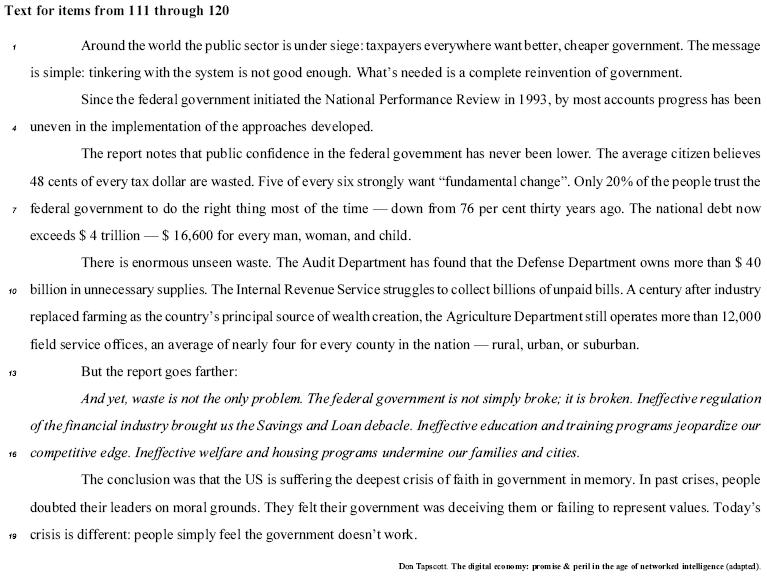
Text for items from 111 through 120.
1 Around the world the public sector is under siege: taxpayers
everywhere want better, cheaper government. The message is simple:
tinkering with the system is not good enough. What’s needed is a
4 complete reinvention of government.
Since the federal government initiated the National
Performance Review in 1993, by most accounts progress has been
7 uneven in the implementation of the approaches developed.
The report notes that public confidence in the federal
government has never been lower. The average citizen believes 48 cents
10 of every tax dollar are wasted. Five of every six strongly want
“fundamental change”. Only 20% of the people trust the federal
government to do the right thing most of the time — down from 76 per
13 cent thirty years ago. The national debt now exceeds $ 4 trillion —
$ 16,600 for every man, woman, and child.
There is enormous unseen waste. The Audit Department has
16 found that the Defense Department owns more than $ 40 billion in
unnecessary supplies. The Internal Revenue Service struggles to collect
billions of unpaid bills. A century after industry replaced farming as the
19 country’s principal source of wealth creation, the Agriculture
Department still operates more than 12,000 field service offices, an
average of nearly four for every county in the nation — rural, urban, or
22 suburban.
But the report goes farther:
And yet, waste is not the only problem. The federal government
25 is not simply broke; it is broken. Ineffective regulation of the financial
industry brought us the Savings and Loan debacle. Ineffective education
and training programs jeopardize our competitive edge. Ineffective
28 welfare and housing programs undermine our families and cities.
The conclusion was that the US is suffering the deepest crisis
of faith in government in memory. In past crises, people doubted their
31 leaders on moral grounds. They felt their government was deceiving
them or failing to represent values. Today’s crisis is different: people
simply feel the government doesn’t work.
Don Tapscott. The digital economy: promise & peril in the age of networked intelligence (adapted).
poor educational standards and training programs put in danger the advantage over competitors.
Certo
Errado