





Seu próximo nível começa aqui
Com a Assinatura Ilimitada, você tem tudo que precisa para sua aprovação.
Com a Assinatura Ilimitada, você combina prática, teoria e método em uma única assinatura com tudo que você precisa para sua aprovação.
No âmbito dos substantivos contáveis e não contáveis, na frase “There is ________ information about the course”, a forma correta para completar a lacuna é:
few.
many.
much.
several.
A distinção entre substantivos contáveis e incontáveis (Countable and Uncountable Nouns) afeta diretamente a concordância verbal e o uso de determinantes. Com base nas regras morfológicas e sintáticas dos substantivos, assinale a alternativa CORRETA.
Substantivos como 'information' e 'furniture' aceitam o artigo indefinido 'a' ou 'an' em contextos específicos.
O termo 'police' é um substantivo coletivo que rege concordância verbal no singular na norma padrão.
A palavra 'criteria' é um substantivo singular de origem grega, cujo plural é formado pelo sufixo 's'.
O substantivo 'news' é morfologicamente plural, mas concorda obrigatoriamente com verbos no singular.
Em determinados contextos, o substantivo information é empregado sem marca de plural e não admite numeral diretamente antes de si. Esse comportamento gramatical indica sua classificação como:
Uncountable.
Countable.
Proper.
Collective.
Consider the following words taken from the text:
I. Stories.
II. Poetry.
III. Form.
IV. Fiction.
Which of the words contains only countable nouns as they are used in the text?
Only I & III.
Only II & III.
Only II, III & IV.
Only IV.
In the phrase it describes his lived ethos, the word ethos is an uncountable noun. With this in mind, mark True (T) or False (F):
( ) The word ethos is uncountable because it refers to the guiding spirit, values, or character of a person, group, or culture.
( ) The word ethos names a general, continuous quality (a way of thinking/behaving).
( ) In the text, you could say two ethoses because it refers to an overarching spirit or attitude that applies to many people.
( ) The use of ethos is functional when the writer wants to talk about individual instances.
Which alternative CORRECTLY fills in the parentheses above?
T-F-T-F.
T-T-T-T.
T-T-F-F.
T-F-T-T.
Which option contains a sentence that is fully acceptable in standard English with regard to countable/uncountable nouns and quantifiers?
We have very few furniture in this classroom.
She gave me an important advice about classroom management.
There is too much information in this worksheet for beginners.
He does not have many homework to check today.
I need a few feedbacks on my teaching strategies.
O domínio de vocabulário e estruturas gramaticais em inglês é essencial para compreender, produzir e interpretar textos — tanto na comunicação oral quanto escrita.
Analise as afirmativas abaixo sobre o emprego correto do vocabulário e das estruturas gramaticais.
1. In English, adjectives usually come after the noun.
2. She can plays the violin very well, is correct.
3. In English much is used with uncountable nouns.
4. The past participle form of eat is eaten.
5. The superlative form of good and bad are, respectively worst and best.
Assinale a alternativa que indica todas as afirmativas corretas.
São corretas apenas as afirmativas 1 e 2.
São corretas apenas as afirmativas 1 e 5.
São corretas apenas as afirmativas 2 e 3.
São corretas apenas as afirmativas 3 e 4.
São corretas apenas as afirmativas 4 e 5.
Which are countable and uncountable nouns examples in the comic strip:
uranium, power.
mines, wells.
company, energy.
energy, mines.
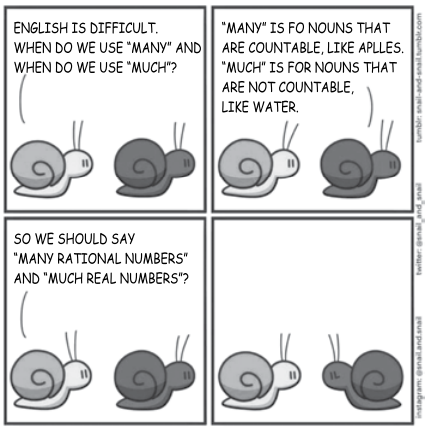
Leia os quadrinhos:
(https://www.reddit.com)
Determinado professor apresenta o cartoon como ponto de partida para a revisão sobre substantivos contáveis e incontáveis, e sobre as palavras “much” e “many” em inglês. Apresenta regras e exemplos sobre o tema.
Está correta a informação apresentada pelo professor na alternativa:
Considerando que “many” refere-se a substantivos contáveis no plural, está correta a frase “We don’t need so many advices, please stop!”.
A resposta no segundo quadrinho precisa ser complementada: “many” é usado com substantivos no plural, e “much” com substantivos incontáveis ou no singular.
A frase “Too much news is never a good thing” está gramaticalmente correta, uma vez que “news” não está no plural, mas é substantivo incontável.
A frase “I don’t have much money to spend” soa pouco natural, já que em frases negativas “much” e “many” não tendem a ser usados.
A frase “Much people came to the parade last Independence Day” é gramaticalmente aceitável já que, embora seja plural como conceito, o substantivo “people” é singular na frase.
In the sentence “Using more than 3 tonnes of flour, 2.7 tonnes of cheese and 88,000 olives,” which of the following nouns are uncountable?
Flour and cheese
Flour and olives
Cheese and olives
Cheese and tonnes
The excerpt in which an idea of countable quantity appears is:
She gave me some advice before the interview.
There was a lot of water on the floor after the storm.
I need three chairs for the meeting.
They offered us some information about the project.
The noun “evidence” (paragraph 2) is uncountable and cannot be pluralized even when referring to multiple pieces of information. Mark the alternative in which the bolded word accepts a plural form.
We’ve just moved in and need new furniture for the living room.
Don’t you think the boys would need orientation on how to play the game properly?
The knowledge we gain from experimenting on new things can be invaluable.
Please, go fetch your baggage at the baggage claim as soon as you leave the plane.
Although an abstraction, people are always hoping to find luck.
Which group of words consists only of uncountable nouns?
Electricity − weather − day.
Knowledge − apple − time.
Milk − money − happiness.
Chair − scenery − sugar.
Love − letter − mistake.
The underlined structure “a few” (l. 06) refers to “experiences and skills” (l. 05), which are countable nouns in the context presented in the article. Mark the alternative below that shows other nouns that could be preceded by “a few”.
chair – idea
music – information
project – advice
furniture – company
water – software
Analyze the sentences below.
I - “The problem she was trying to solve (…)”.
II - “First, start with one simple question.”
III - “(…) or a complete exit from social media – may feel impractical.”
IV - “Last of all, make technology work for you”.
V - “(…) eager for a respite from some of the very products they helped build”.
Choose the correct answer:
In sentence III, by using the modal verb “may”, the author intended to politely ask for permission.
While in sentence I “problem” is a countable noun; in sentence V, “build” is an uncountable noun.
The adverb “respite”, in sentence V, is used in a sense of manner.
“Last of all” and “First” are discourse markers in sentences IV and II, respectively.
The past perfect is the verb tense in sentences I and III.
Which noun does not have the correct definition? Choose the incorrect answer. (Countable and Uncountable Nouns)
Coat (countable).
School (countable).
Office (uncountable).
News (uncountable).
Baggage (uncountable).
The sentence "less people attended the event" is grammatically correct because "less" is commonly used with countable nouns.
Certo
Errado
Check the alternative that has an uncountable noun:
package (§ 15).
suitcase (§ 8).
money (§ 16).
book (§ 21).
plane (§ 1).
Complete: “______ tigers _____ pumas are domestic animals.”
Both / nor.
Neither / or.
And / both.
Neither / nor.
“Spotify made a lot of money in Q1: yesterday (April 23, 2024), the streaming music giant announced that last quarter its revenue increased by 20%. The smash report comes after Spotify cut costs last year, which included laying off more than a quarter of its workforce. The company also raised prices ___ 2023 for the first time in a decade as it further expanded beyond music into audiobooks and other categories”.
(Adapted from: https://www.morningbrew.com/daily/issues/whi ffed)
Analyze the assertions below.
I - "In" correctly fills the gap in the text.
II - There is a phrasal verb in the sentence “(…) which included laying off more than (…)”.
III - The words in italics are respectively: an uncountable noun; a personal pronoun; the comparative form of the adjective “quart”.
It is correct to affirm that:
Only I and II are correct.
Only I is correct.
Only I and III are correct.
Only II and III are correct.
Only III is correct.