







Seu próximo nível começa aqui
Com a Assinatura Ilimitada, você tem tudo que precisa para sua aprovação.
Com a Assinatura Ilimitada, você combina prática, teoria e método em uma única assinatura com tudo que você precisa para sua aprovação.
The word “former” (line 5) refers to someone who created the Treaty.
Choose the correct translation to the words in bold:
“Depression, an extreme feeling of sadness and hopelessness, can be the result of continued and increasing stress.”
desesperança
solidão
inquietude
tristeza
depressão
“Cut it out!”.
What does this sentence mean?
Stop it now!
Cut this thing out!
Come here!
Go out!
Go away!
Schools of thought: can mindfulness lessons boost child
mental health?
Children are taking 10 minutes out from the hurly burly school
day to reflect on their thoughts and their feelings. Some ground
themselves by thinking about their feet on the floor, while others
concentrate on their breathing.
This is mindfulness, the lessons quickly growing in popularity
as an antidote to the stress of being a young person in the 21st century,
be it pressure to perform in exams, social media, or the obsession with
body image that is reported to even affect primary age children.
Children are learning about their brains and how to deal with
unruly thoughts – to control emotions such as anger and fear. It is no
longer head, shoulders, knees and toes, but amygdala, hippocampus
and pre-frontal cortex.
The most recent NHS survey of young people’s mental health
in 2017 shows one-in-eight 5- to 19-year-olds in England has a
diagnosable mental health condition. Hospital admissions for anorexia
alone more than doubled in the eight years to 2017/18.
Stress is a known barrier to learning and a growing number of
schools are targeting the emotional health of pupils through schemes
such as meditation, mindfulness and the provision of mental health first
aiders and buddies.
The Mental Health Foundation charity wants emotional
wellbeing to be at the heart of the school curriculum, and has chosen
body image as the key theme of this year’s Mental Health Awareness
Week. Dr Antonis Kousoulis, its assistant director, said its survey last
year found 47% of people aged 18-24 had experienced stress over their
body image to the extent of being overwhelmed or unable to cope.
“Social media has certainly played a part,” he says. “Historically, it was
the mirror that was the main driver of perception of our image and how
we thought others perceived us. Nowadays, young people are exposed
almost on a 24/7 basis to manipulated and heavily edited images,
whether that’s in advertising or photos of their friends.”
Over the past five years there has been a proliferation of
mindfulness organisations and companies selling lesson plans and staff
training to schools. But does it work?
Secondary school teacher Richard Burnett, who founded the
Mindfulness in Schools Project 10 years ago, warns against “quick fix”
approaches. “We are a charity started by teachers who wanted to teach
children how best to manage their thoughts and feelings and deal with
the rollercoaster of being a young person,” he says.
It has two training courses for teachers – one aimed at
secondary students and another for younger classes. “It’s about training
your attention to notice what is going on. If you are aware of that, you
can choose how to respond, for example to manage the amygdala, the
part of the brain that detects fear and prepares a response,” he says.
Emotional disorders are on the rise, and we should instil
something in our children and young people about coping with stress,
advises Lee Hudson, the Royal College of Paediatrics and Child
Health’s mental health lead. But should it be mindfulness? There is
evidence that the process can bring benefits to adults, he says. “[But]
the evidence for its effectiveness with children is not yet sufficiently
robust and we need more research. However, some schools are rolling
it out and children seem to enjoy it – and it unlikely to cause harm.”
(Available in: https://www.theguardian.com/society/2019/may/16/mindfulnesslessons-
child-mental-health. Accessed on May 17th, 2019. Adapted.)
The word 'overwhelmed’' highlighted in paragraph 6 could be best replaced by
thankful.
devastated.
unhappy.
cheered up.
reckless.
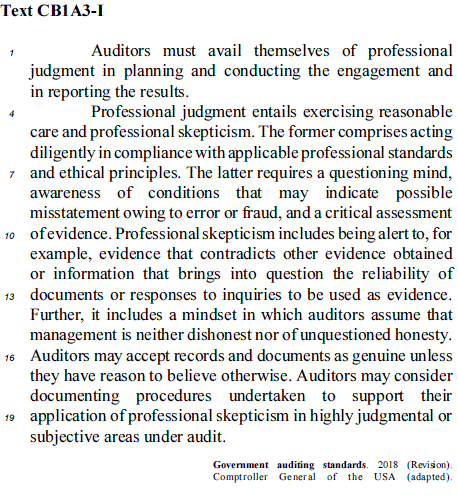
Based on text CB1A3-I, decide which of the statements below is correct.
The opposite of “former” (R.5) in this particular context is current.
In “it includes” (R.14) , “it” refers to “evidence” (R.13).
“Further” (R.14) is a more informal but equally acceptable form of furthermore.
In “may consider documenting” (R. 17 and 18), “documenting” can be correctly replaced with document.
In “under audit” (R.20), “under” can be correctly replaced with below.
Embracing Change
I have taught brilliant students of color, many of them seniors, who have skillfully managed never to speak in classroom settings. Some express the feeling that they are less likely to suffer any kind of assault if they simply do not assert their subjectivity. They have told me that many professors never showed any interest in hearing their voices. Accepting the decentering of the West globally, embracing multiculturalism, compels educators to focus attention on the issue of voice. Who speaks? Who listens? And why? Caring about whether all students fulfill their responsibility to contribute to learning in the classroom is not a common approach in what Freire has called the “banking system of education” where students are regarded merely as passive consumers. Since so many professors teach from that standpoint, it is difficult to create the kind of learning community that can fully embrace multiculturalism. Students are much more willing to surrender their dependency on the banking system of education than are their teachers. They are also much more willing to face the challenge of multiculturalism.
Multiculturalism compels educators to recognize the narrow boundaries that have shaped the way knowledge is shared in the classroom. It forces us all to recognize our complicity in accepting and perpetuating biases of any kind. Students are eager to break through barriers to knowing. They are willing to surrender to the wonder of relearning and learning ways of knowing that go against the grain. When we, as educators, allow our pedagogy to be radically changed by our recognition of a multicultural world, we can give students the education they desire and deserve. We can teach in ways that transform consciousness, creating a climate of free expression that is the essence of education.
Adapted from hooks, b. Teaching to Transgress: A Education as a Practice of Freedom. London/New York: Routledge, 1994.
Read the highlighted sentence in the text above. The cohesive device “since” can be substituted for:
The word “terrible” in paragraph 13, it could be replaced by:
Awful
Marvelous
Prodigious
Solemn
Mark the alternative that correctly replaces the expression ‘Bearing this in mind’ (l.25).
The word “Thus”, in the second paragraph, can be correctly replaced by
“Also”.
“So”.
“However”.
“Or else”.
“But then”.
The expression “as well as” in “as well as honors for Mahershala Ali as Best Supporting Actor and Nick Vallelonga” indicates
Call your mother immediately when you can—she's very worried about you.
According to the context, the bold item can be replaced by:
As soon as.
Therefore.
By the way.
Besides.
Read this excerpt from one of the previous texts:
“There must be training sites where teachers have the opportunity to express those concerns while also learning to create ways to approach the multicultural classroom and curriculum.”
Without changing the meaning of the sentences, it is correct to substitute the modal must in the beginning of the sentence for:
“When Andy got home, he found the door ajar.” Choose the option that defines the underlined word.
Slightly open.
Wide open.
Locked.
Broken.
The word “however” highlighted in paragraph 4 is closest in meaning to
thereafter.
nevertheless.
therefore.
thus.
The best word to complete this sentence “_______ the decline in the traditional pub…” (paragraph 6) is
But.
Despite.
And.
Because
Select the words that fill the blank of lines 05, 06 and 22.
especially – memoir – through
especially – memoair – throu
especially – memory – trough
specially – memoair – throu
specially – memoir – thorugh
Match the meaning of the following words:
1- live part;
2- puncture;
3- overload;
4- insulation;
5- troubleshooting.
( ) a material having a high resistance to the flow of electric current;
( ) the term used when a disruptive discharge occurs through a solid dielectric. A disruptive discharge in a solid dielectric produces a permanent loss of dielectric strength; in a liquid of gaseous dielectric, the loss may be only temporary;
( ) electric conductors, buses, terminals, or components that are uninsulated or exposed and an electric shock hazard exists;
( ) a procedure for the purpose of locating and identifying electrical problems within an electrical system;
( ) operation of equipment in excess of normal, full-load rating, or of a conductor in excess of rated ampacity that, when it persists for a sufficient length of time, would cause damage or dangerous overheating.
2-4-1-3-5.
1-3-4-5-2.
4-2-1-5-3.
5-2-1-4-3.
3-4-1-5-2.
Considerando as novas possibilidades de interação que geram profundas transformações nas sociedades, associe os conceitos às respectivas definições.
Conceitos
(1) Culture
(2) Globalization
(3) Multiculturalism
(4) Interculturality
(5) Transculturality
Definições
( ) Often used, in literature, in the following meanings: cross-cultural competence, identitary continuum and plural sense of self.
( ) Complex concept viewed, after the 1970s, as a permeable and very dynamic ‘web of significance’ woven by human practices and representations.
( ) Broadly defined as an unprecedented world stage of increasing economic, social and cultural interconnectedness, according to widely cited authors Held and Mc Grew.
( ) Often used to express the right to difference in relations to a dualistic nature between minorities or marginalized cultures and the majority or dominant cultures, which have tended to be conflictive.
( ) More properly used to characterize specific public policies for managing culturally diverse societies in the industrial world, such as Canada, New Zealand, the USA and the United Kingdom.
A sequência correta dessa associação é
(5); (1); (2); (4); (3).
(3); (4); (1); (5); (2).
(5); (4); (3); (2); (1).
(4); (3); (2); (5); (1).
(5); (4); (2); (1); (3).
Analyze the items below.
I - […] there were digs thrown at me for being from an one-parent family.
II - Witness a history of racial injustice at two new museums in Alabama and Mississippi.
III - Please switch off your terminal, leave it for one minute and then reset it.
IV - A dazed Ousted was down on the ground for a minute but stayed in the game.
Observing the underlined noun phrases, choose the correct option.
The items I, II and III, only.
The items II, III and IV, only.
The items I and IV, only.
The items II and IV, only.
Com relação às escolhas lexicais do autor do texto, pode-se afirmar que:
em “As a child, she was told that they were just growing pains...” (l. 5), “...something known medically as rhabdomyolysis...” (l. 8), os itens sublinhados podem ser substituídos por WHILE sem prejudicar o sentido.
suddenly (l. 5), medically (l. 8) e unlikely (l. 17) indicam o mesmo tipo de advérbio.
moved (l. 38), surprised (l. 38) e suggested (l. 39) são empregados como verbo.
damage (l. 11) pode ser substituída por wound sem alterar o sentido do contexto.



