







Seu próximo nível começa aqui
Com a Assinatura Ilimitada, você tem tudo que precisa para sua aprovação.
Com a Assinatura Ilimitada, você combina prática, teoria e método em uma única assinatura com tudo que você precisa para sua aprovação.
Identify the word in which “ough” is pronounced in the same way as the “ough” in “Even though” (line 12).
through
cough
rough
dough
enough
Match the words in the first column below with their respective synonyms, in the second column, according to the meaning they have in the text.
( ) reliable (l. 15)
( ) nefarious (l. 19)
( ) overall (l. 25)
(1) dubious
(2) evil
(3) dependable
(4) generally
(5) untrustworthy
(6) global
The sequence that adequately fills in the parentheses, from top to bottom, is
Analyze the fragment below.
“Baur said the longevity seen among the mutant mice _____________________________ to have resulted from simply fixing a health problem among the control mice, because those animals __________________________ healthy and were reasonably long-lived.”
Choose the best option that completes the paragraph above.
Doesn’t appear – seemed.
Appears – seems.
Don’t appear – seemed.
Appear – seemed.
Na frase “Although she has been hospitalized nearly 30 times and has seen numerous doctors, no one understands why this is happening...” (l. 2-3), a palavra destacada, ALTHOUGH, pode ser substituída prejudicando o mínimo possível o contexto por:
besides.
indeed.
even though.
likewise.
Choose te best option to complete the frases respectively:
The …………… is survived by his wife and two children.
A sick man needs a …………………… room.
I will let you do this now but don’t take it as a …………………, because I will not let you do it again.
In summer, the ………………… is hot.
deceased - quite - president - whether
deceased - quiet - precedent - weather
deseased – quit - precident - wheter
diseased - quiet - president - whether
deceased - quite – precedent - weather
The word “within” (line 36) was used in the text as a opposition of “outside” (line 37).
Certo
Errado
Choose the CORRECT answer. (Months of the Year)
What is the fifth month of the year?
May.
April.
June.
July.
Na fala do professor – I expect you all to be independent, innovative, critical thinkers who will do exactly as I do –, a palavra destacada em negrito pode ser corretamente substituída por
whom.
that.
which.
what.
whose.
Mark the option that best completes the dialog: “A: I’m so sorry, I’ve just spilled some of my wine on your carpet.”
“B: Don’t worry, I’ll clean it right away.”
“B: No problem, I’m going to clean it right now.”
“B: That’s alright, if you scrub it, the stain is going to go away.”
“B: Don’t worry, if you scrub it, the stain would go away.”
Furthermore is a correct alternative for "Besides" (line 4).
Without a change in meaning, the word “range” (line 16) can be replaced by measure.
Look at the clock. Complete the sentence below with the correct hour and choose the CORRECT answer. (Hour)
I get up at six fifteen. I have breakfast and I go to work at ________.
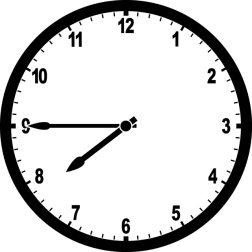
Seven o'clock.
Half past seven.
A quarter to eight.
Eight o'clock.
Still in practical terms, focusing on lexical terms may be a challenge for the teacher and the student. Penny Ur (2012, p. 69) alerts teachers to the importance of revising vocabulary instead of testing students on it so as to “consolidate and deepen students’ basic knowledge”. It’s important to focus the revision on single-items as well as items in context, using a wide range of exercises, which means, for example:
I conducting dictations.
II having students brainstorm in groups.
III doing a quick bingo.
IV composing stories together.
V finding collocations on websites or dictionaries.
The alternative that best matches the exercises suggested above with their target language is:
single-items; all of them.
items in context; all of them.
single-items: I, III, V; items in context: II and IV.
single-items: IV and V; items in context: I, II and III.
single-items: I, II, III; items in context: IV and V.



