





Seu próximo nível começa aqui
Com a Assinatura Ilimitada, você tem tudo que precisa para sua aprovação.
Com a Assinatura Ilimitada, você combina prática, teoria e método em uma única assinatura com tudo que você precisa para sua aprovação.
O 'Present Perfect Continuous' é utilizado para descrever ações que começaram no passado e continuam no presente, enfatizando a duração do processo, como na frase 'I have been teaching English for ten years'.
Certo
Errado
Analyze the cartoon below by Ellis Rosen:
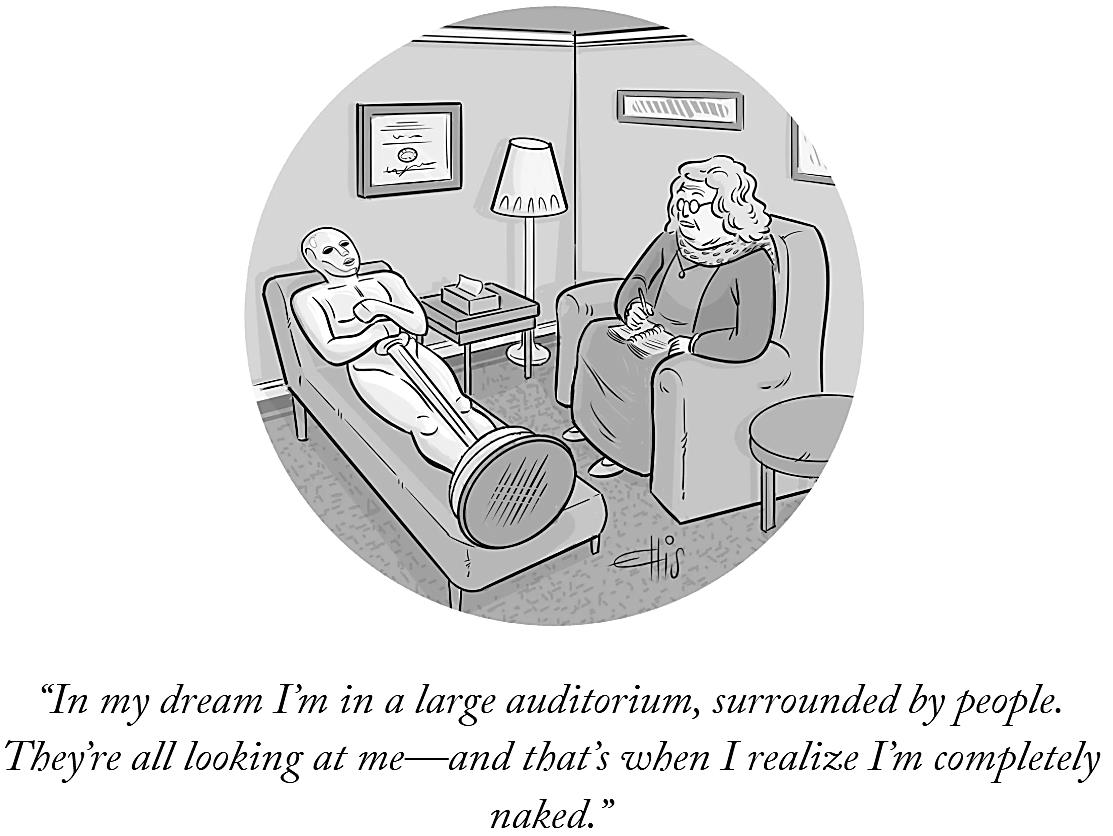
(Available at: https://www.newyorker.com/gallery/and-the-oscar-goes-to – text specially adapted for this test).
The present continuous tense has the same use as in “They’re all looking at me” in which of the alternatives below?
We’re meeting at 10, don’t be late.
She’s driving, can she call you later?
My brother’s staying with our parents until he recovers.
Aren’t they getting married in July?
He’s working at the hotel this summer, but then he’ll resume his studies.
The sentence “She has been teaching for ten years” is an example of which tense? Select the correct tense.
Present Perfect.
Present Continuous.
Present Perfect Continuous.
Past Perfect.
Identify the verb tense used in the sentence:
"By 1942 some citizens were living on as few as 1,110 calories per day."
Select the correct alternative.
Past continuous.
Present continuous.
Past perfect.
Present perfect continuous.
In the fragment “Diplomatic institutions adopting such technologies” (first sentence of the second paragraph), “adopting” describes an ongoing action that started in the past and continues in the present, since it is in the present perfect continuous.
Certo
Errado
You are revising a formal report that must foreground the process rather than the agent. Select the rewrite that preserves the original present progressive meaning and maintains a formal passive focus.
The submissions are being reviewed by the team at the moment.
The submissions have reviewed by the team at the moment.
The submissions were reviewed by the team at the moment.
The team reviews the submissions at the moment in a continuous way.
The team is review the submissions at the moment in the report.
The tense used in the underlined part of the sentence in the excerpt “It has been a year since the Hamas-led terrorist attacks impelled Israel to launch a retaliatory offensive in Gaza.” is
Past Perfect Tense.
Present Perfect Continuous Tense.
Present Perfect Simple Tense.
Simple Present Tense.
Mark the item which CORRECTLY displays the tense and aspect of the underlined verbs.
I have helped my neighbor too much this week.
Present perfect.
Present simple.
Present continuous.
Present perfect continuous.
The text contains several instances of passive voice constructions. Examine this sentence: "Productivity forecasts are expected to be downgraded by the OBR, heaping yet more pressure on the chancellor's budget choices." This sentence uses passive voice with an infinitive construction. Understanding the transformation between active and passive voice, particularly with complex verb structures, is crucial for advanced writing. Which of the following correctly identifies the grammatical structure and appropriate active voice transformation?
Present perfect passive structure. Active form: "The OBR has expected downgrading productivity forecasts already."
Present simple passive with reporting verb plus infinitive passive. Active: "Analysts expect the OBR to downgrade forecasts."
Present continuous passive structure. Active: "The OBR is expecting to downgrade productivity forecasts currently."
Double passive construction that is grammatically incorrect. Should be rewritten: "The OBR downgrades productivity forecasts."
It is correct to say that the underlined occurences 1 and 2 found in text 3 contain examples of:
The present perfect tense.
Past Perfect tense.
Present perfect continous tense.
Present progressive.
Identify the verb tense in the following sentence.
She had been living in Italy for 10 years.
Present perfect continuous
Past Perfect continuous
Past
none of the above
“…chatbots have been created as a type of artificial…” Which verb tense is expressed in “Have been created”?
Present perfect.
Present perfect continous.
Simple past-passive voice.
Present perfect-passive voice.
Match the verb forms to their correct uses:
1 - "Have been working"
2 - "Were working"
3 - "Had worked"
4 - "Has worked"
( ) Past perfect
( ) Present perfect continuous
( ) Past continuous
( ) Present perfect Identify the correct matching, respectively:
1 - 3 - 4 - 2
4 - 2 - 1 - 3
3 - 1 - 2 - 4
3 - 4 - 1 - 2
1 - 4 - 3 – 2
Read the following dialogue and answer the question below:
Sarah: Hey Tom, you look exhausted! What's going on?
Tom: Oh, hi Sarah. Yeah, I've been quite busy lately.
Sarah: Really? What have you been up to?
Tom: Well, I (1)_____ (work) on a challenging project at the office. It's been pretty intense.
Sarah: How long (2)_____ you _____ (deal) with this project?
Tom: It's been about three months now. I (3)_____ (put) in extra hours almost every day.
Sarah: That sounds stressful. (4)_____ you _____ (have) any time for yourself?
Tom: Not much, to be honest. I (5)_____ (neglect) my hobbies and social life lately.
Choose the correct option to fill in the blanks (1-5) in the dialogue above, considering the appropriate use of the Present Perfect Continuous tense.
1. have working, 2. have / dealt, 3. put, 4. Are / having, 5. am neglecting
1. have worked, 2. are / dealing, 3. am putting, 4. Do / have, 5. neglect
1. had been working, 2. have / been dealing, 3. have put, 4. Did / have, 5. have neglected
1. have been working, 2. had / been dealing, 3. have been putting, 4. Had / been having, 5. had been neglecting
1. have been working, 2. have / been dealing, 3. have been putting, 4. Have / been having, 5. have been neglecting
Analyze the sentences below:
1. “Agatha Christie is one of the rare writers who has completely transcended pop culture...”
2. “[...] Christie is something else entirely...”
3. “[...] Christie injected a certain thrilling literary adventure into her writing...”
It is correct to affirm that:
The first sentence is an example of present continuous tense because of its structure: has + participle of the verb to transcend with the adjective completely; the second is in the present using the verb to be; the third is in the simple past using -ed to mark that it is a regular verb.
The first sentence is an example of present perfect tense because of its structure: has + participle of the verb to transcend; the second is in the past using the verb to be; the third is in the simple past using -ed to mark that it is a regular verb.
The first sentence is an example of present perfect continuous tense because of its structure: has + participle of the verb to transcend; the second is in the present using the third person of plural of the verb to be; the third is in the simple past using -ed to mark that it is an irregular verb.
The first sentence is an example of present perfect tense because of its construction: has + participle of the verb to transcend with an adverb. completely to emphasize it; the second is in the present using the verb to be for the third person of singular; the third is in the simple past because of the regular verb with -ed in the end.
The first sentence is an example of present perfect tense because of its structure: has + infinitive of the verb to transcend; the second is in the present using the verb to be; the third is in the simple past using -ed to mark that it is a regular verb
Read.
Teens feel more complex feelings more deeply
Once puberty has started, the characters that make up Riley’s emotions find that pressing any buttons gets a bigger reaction. And psychologically, that makes sense.
“One of the main features of emotional development in adolescence is this easy arousability of both positive and negative emotions,” Steinberg said. Their feelings are stronger than those of either children or adults.
And in adolescence, the brain has developed more of a capacity for abstract thought, bringing with it more complex emotions, said Damour, author of “The Emotional Lives of Teenagers: Raising Connected, Capable, and Compassionate Adolescents.”
They have more anxiety because they can more easily imagine future problems. They become more embarrassed because they better understand what others may be thinking of them. They become envious because they can see comparisons better between themselves and others, she added.
And ennui isn’t just a funny side effect. Acting like they don’t care is often an important escape hatch for teens in a social conundrum, Damour said.
“These are sophisticated emotions that require neurological development to come on the scene,” she said.
Available at: https://edition.cnn.com/2024/06/15/entertainment/teen-emotions-inside-out-wellness/index.html. Accessed: July 23, 2024.
It is possible to affirm that the term “has developed” extracted from the passage above is classified as
Simple Present.
Past Perfect.
Present Perfect.
Present Perfect Continuous.
Past Progressive.
The words “receiving” (line 7), “seeing” (line 7) and “having” (line 8) are examples of the present continuous or present progressive tense.
Certo
Errado
In the sentence, “Marine trash has been harming marine life for a very long time.”, there is an example of:
Present perfect tense.
Present perfect continuous tense.
Past perfect tense.
Past perfect continuous tense.
Simple past tense.
Identify the sentence that correctly employs the present perfect continuous tense:
He has been studying English since 5 years.
They have waited for us since the morning.
She has been working here for over a decade.
I have lived in this city for three years.
We have been knowing each other since childhood.
Choose the option that is true about the following sentence: “In the case of Brazil, English instruction Has Been Gaining more importance in recent years, especially with the inclusion of the subject as compulsory at the secondary level (beginning in 6th grade) in all public and private schools.” (2º§)
The highlighted verb tense is Present Perfect Continuous. Its use is justified due to the fact that we know the duration (in recent years) of the activity.
The highlighted verb tense is Present Perfect. Its use is justified because the sentence shows an action that has happened in a period of time up to the present.
The highlighted verb tense is Present Perfect. Its use is justified due to the fact that the sentence conveys an idea of a new stage that schools in Brazil have experienced, especially in the 6th grade.
The highlighted verb tense is Present Perfect Continuous. Its use is justified because the sentence implies an idea of an action that started in the past and has already been completed (English instruction).