





Seu próximo nível começa aqui
Com a Assinatura Ilimitada, você tem tudo que precisa para sua aprovação.
Com a Assinatura Ilimitada, você combina prática, teoria e método em uma única assinatura com tudo que você precisa para sua aprovação.
Information questions, also known as Wh-questions, are essential tools for gathering data and maintaining social interaction in English. In what concerns the formation and usage of these interrogative structures, choose the correct alternative.
The question word 'Whose' is used to ask about the reason for an action, and it must be always followed by a verb in the third person singular of the present.
In indirect questions, the word order is exactly the same as in direct questions, and the use of 'if' or 'whether' is strictly forbidden by municipal law.
Tag questions are formed by repeating the main verb of the sentence in its affirmative form at the end of every interrogation to show extreme doubt.
Wh-questions are formed using an interrogative word (like who, where, when, why) and usually follow a subject-auxiliary inversion in the main clause.
Choose the option that correctly completes the following blanks.
A coffee shop is a place _____ people usually go to relax or work, and a teacher is someone _____ helps students learn new skills.
who / which
that / where
where / who
which / whose
when / who
Em estruturas interrogativas, certos pronomes introduzem perguntas sobre pessoas, objetos, tempo ou lugar. Na frase ___ did you meet yesterday?, o pronome adequado para perguntar sobre pessoa é:
Who.
Where.
When.
Which.
Celse-Murcia (2013) brings a brief example is a figurative episode where English is taught as a foreign language to beginner students. The teacher has introduced the grammatical topic of question formation explaining that Yes - No Questions are made in English by inverting the subject of a sentence with the operator in the sentence. In this initial lesson, she defines the operator as some form of the verb to be, here ARE. She has provided the class with examples, and she now gives them practice in forming Yes - No Questions. She makes a statement and tells the students to transform it into a question.
Teacher: We are studying English.
Students: Are we studying English?
Teacher: Yes, we are. We are using a book.
Students: Are we using a book?
Teacher: No, we aren’t. We are making questions.
Students: Are we making questions?
Later in the morning, a girl turns to the teacher and asks:
We are going outside for recess?
The teacher silently takes note of the students' failure to invert the subject with the operator.
According to this example, it is correct to say that for the teacher,
vocabulary is about the form of the language.
speaking accurately is about the form of the language.
learning to form questions is about the form of the language.
grammar is about the form of the language.
What is the interrogative form of the excerpt “There will be delays on other fronts” (l. 12) in the same verb tense as the original sentence?
Do will be delays on other fronts?
Will been there delays on other fronts?
Will there be delays on other fronts?
Are there delays on other fronts?
Do delays will be on other fronts?
Read the following dialogue.
Mr. Humphrey: All right, are you excited for today’s class?
Students: Yeah.
Mr. Humphrey: Okay! Anna, could you read the article on page 271?
Anna: Sure, Mr. Humphrey. [Anna finishes reading]
Mr. Humphrey: Now, let’s discuss the author’s main point of view, shall we?
Analyze the assertions below based on the dialogue.
I. Mr. Humphrey uses the modal verb “could” to make a polite request.
II. “All right”, “yeah”, “okay”, “sure” and “now” are used as discourse markers.
III. In the last sentence, “shall we” is being incorrectly used as a tag question.
Then choose the CORRECT alternative.
Only I is correct.
Only III is correct.
Only I and III are correct.
Only I and II are correct.
Only II and III are correct.
Mark the CORRECT item to fill in the blank.
The director, ______ film won several awards, will be speaking at the conference.
who
whose
which
where
The questions Mr. Oil Company asked Ralph: You want coal? You want oil and gas? You want nuclear energy? You want solar or wind power? are acceptable forms in colloquial English. In standard English, however, the word order of those sentences is applied for the affirmatives. The option with the correct interrogative word order is:
He is a fan of Marvel movies.
Will you open the window for me, please?
How you feel today?
Wanna try that again?
Which of the following sentences is grammatically CORRECT?
I have an friend who works in finance.
The tiger is an endangered species.
She is the best singer I ever meet.
I can't wait to visit a Eiffel Tower when I am in Paris.
Analyze the sentences below:
I. Jimmy, _____ sister is really sweet, just got in a fight with his classmate.
II. These are the books and authors ______ our professor recommended.
III. That house, ______ was built in 1970, used to belong to my family.
Mark the alternative that fills in, correctly and respectively, the blanks in the sentences above.
whose - that — which
which —- who — that
whom - who - where
who - whom — which
that —- whose — that
The blank numbered as (2), in “__________(2) are the Sunday scaries? The Sunday scaries typically manifest in two ways: feelings of depression that the weekend is ending, feelings of anxiety about the week to come, or both. These feelings typically start on Sunday afternoon.”, could be CORRECTLY filled in:
Where.
Why.
Because.
What.
Whose.
English is used as an intranational and international language, rather than as a native language only (B.B. Kachur, 1985). The author’s well known representation of three concentric circles of English is the following: Figura 1
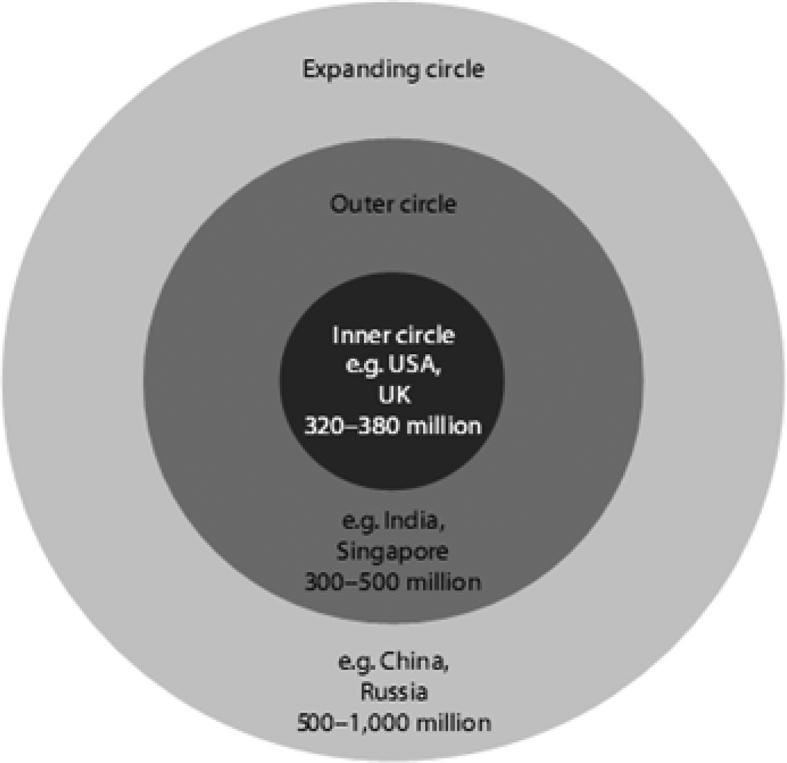
Fonte: Celce Murcia, 2013
The expanding circle is related to
countries and regions where English is the native language of the majority of the population.
countries where English is a dominant foreign language used in limited domains but is beginning to become or has become a lingua franca.
countries where English has had a long history of use and where local L2 varieties have developed and become codified through extensive use.
countries where English is a dominant language for reading and writing for the majority of the population.
No trecho do segundo parágrafo “Albert Marckwardt (1972) saw these “changing winds and shifting sands” as a cyclical pattern where a new paradigm of teaching methodology emerged”, a palavra destacada em negrito pode ser corretamente substituída por
who.
whose.
which.
in that.
in which.
The teacher praised the student whose project showed great creativity and originality. She explained that academic success depends not only on knowledge but also on the ability to think critically. The class admired the student, whose dedication was evident throughout the semester.
In the passage, the word “whose” is used to:
Replace the subject of the sentence, functioning exactly like who.
Indicate possession, linking a person to something that belongs to them.
Express a cause, functioning similarly to because.
Indicate a place, functioning similarly to where.
Choose the option that correctly completes the sentence using a relative pronoun:
“The teacher praised the student ____ project on environmental conservation won first prize.”
which
whose
who
whom
Qual a forma interrogativa da frase "He can swim"?
He can swim?
He cans swim?
Swim he can?
Can he swim?
As regards text II, analyze the assertions below.
I. AI’s ability to conduct human-like conversations opens up possibilities for adaptive tutoring; however, AI-based feedback systems cannot help students fine-tune their writing skills.
II. According to some research, certain kinds of prompts can help children generate more fruitful questions about learning.
III. As a teaching assistant, AI can execute many automated routine tasks that keep teachers from investing more time with their students, such as drafting lesson plans and designing worksheets.
Choose the CORRECT answer.
Only I is correct.
Only I and II are correct.
Only II is correct.
Only II and III are correct.
Only III is correct.
Concerning interrogative questions, the correct option is
What did happened to you?
What he said to you?
When you saw him?
Who called you a “puppet”?
Analyze the statements below about the excerpt “The Sagrada Família was founded as an expiatory church” (l. 17):
I. It is an active voice structure.
II. It is in the simple past.
III. Its interrogative form is “Was the Sagrada Família founded as an expiatory church?”.
Which ones are correct?
Only I.
Only II.
Only III.
Only II and III.
I, II and III.
Read the following sentences about “Uso e formação de Wh-questions e outras estruturas interrogativas.”
1. Wh-questions begin with what, when, where, who, whom, which, whose, why and how.
2. We use the ‘wh-questions’ to ask for information. The answer can be yes or no. We expect an answer which gives information.
3. We usually form ‘wh-questions’ with wh- + an auxiliary verb (be, do or have) + subject + infinitive verb or with wh- + a modal verb + subject + main verb.
4. When what, who, which or whose is the subject or part of the subject, we do not use the auxiliary. We use the word order subject + verb.
Select the option that presents the correct sentences.
Only sentence 2 is correct.
Only sentence 3 is correct.
Only sentences 1 and 4 are correct.
Only sentences 2 and 3 are correct.
Only sentences 2 and 4 are correct.