







Seu próximo nível começa aqui
Com a Assinatura Ilimitada, você tem tudo que precisa para sua aprovação.
Com a Assinatura Ilimitada, você combina prática, teoria e método em uma única assinatura com tudo que você precisa para sua aprovação.
Choose the correct form of the verb to complete the sentence: "By the time we arrive at the concert, the main band _______ already _______."
will have, started
is, starting
has being, started
will, start
had, started
Consider the sentence below:
"If you ___ the chance to visit one foreign country, which country ___ it?"
Choose the option that correctly fills the blanks in the following conditional sentence:
had / should
has / will
had / will be
had / would be
have / will
Considering the sentence: “I'm not sure where Amanda is. She _______________ home, I suppose.” which one of the following is the correct verb form?
shall have gone
must has gone
can have gone
could go
might have gone
In the sentence "It is essential that he __________ on time," which verb form should be used to complete the sentence?
arrives
arrive
arriving
arrived
was arrivving
Which of the following sentences correctly uses a regular verb in the past tense?
They runned faster than the others.
She sended the email yesterday.
He wanted to go to the park.
I choosed the wrong answer.
We drived all night.
The tense or form of the verbs in the sentences below is correct, EXCEPT in:
Only through research and tracking can the storks be monitored by the team.
Unless we keep a safe space for them, storks won’t return for good.
The storks had been going from England for years when they returned.
Had the journalist brought a cameraman, she would have got a great nature video record.
Verb phrases contain a verb as their central element. However, sentences that include a modal verb (such as can, may might etc) can also be considered a verb phrase, since the modal verb will change the meaning and tone of the main verb. It is important to note that modal verbs is the only exception to verb phrases without a verb as its central element.
Certo
Errado
In English, the subjunctive mood is only used in hypothetical situations and is identical in form to the indicative mood in all tenses except the present.
Certo
Errado
Choose the alternative with verbs that correctly and respectively complete gaps (1), (2) and (3) in paragraphs 1 and 2.
explaining, practise, overcame
explains, practise, overcame
have explained, practising, overcome
explains, practised, overcome
explain, practising, overcomes
Analyze the following sentences.
I. Every summer, Anna ____ on a beach and reads.
II. John _____ me he would come to my party.
III. Are you ______________________ Japanese food?
IV. Our last meeting achieved absolutely nothing; it was a complete _______ of time.
Mark the alternative that fills out, correctly and respectively, the gaps in the sentences:
lies; told; used to eating; waste.
lays, said; used to eating, waste.
lies; said; used to eat, spend.
lays; told; used to eat, waste.
“But he was also somehow proud.” The word somehow is
a verb.
an adjective.
an adverb.
a now.
Which of the following sentences uses a subjunctive mood correctly?
If she was taller, she could reach the top shelf.
I wish she was here with us right now.
It is crucial that he be informed of the changes immediately.
He suggests that everyone donates generously.
INSTRUÇÃO: Consider the following text to answer this question.
Luisa and Marina are visiting their grandmother's house. Her grandmother ______ to donate her comic book collection to them:
− Girls, I have a gift for you that was from your great grandfather. That he ______ me and today will be yours. I ______ all these comic books for years. They are unique editions that my father ______ to me more than 30 years ago. But, first, you need to promise that you will take care of them just like I ______.
Fonte: O elaborador, 2024.
Select the alternative that presents the words that correctly fill in the gaps, considering the order of the text.
decides, gave, keep, buy, did.
decided, gave, kept, bought, did.
decided, give, kept, buy, did.
decided, gave, kept, bought, do.
decides, give, keep, buy, do.
Leia a tirinha abaixo:
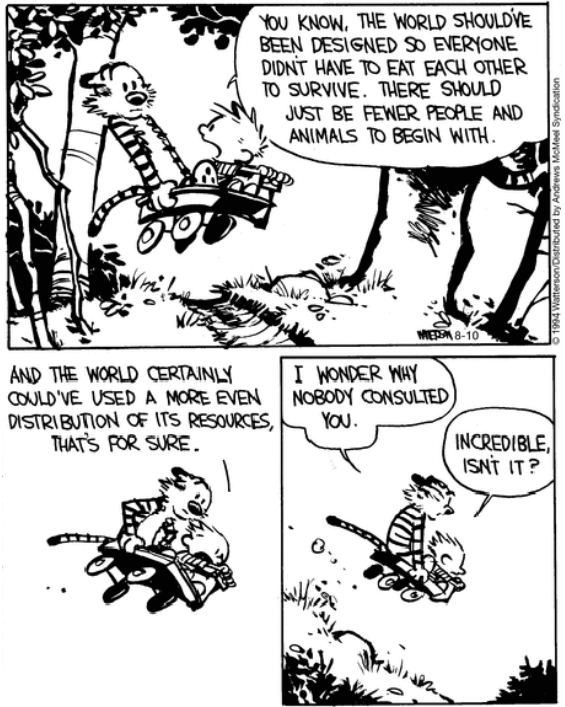
WATTERSON, Bill. Calvin and Hobbes. Disponível em: https://www.gocomics.com/calvinandhobbes/2024/08/10. Acesso em: 12 ago. 2024.
Sobre os recursos linguísticos usados no quadrinho, avalie se as afirmações abaixo são verdadeiras (V) ou falsas (F).
I. Nos trechos “The world should’ve been designed” e “The world centainly could’ve used”, o uso de ‘should’ve been’ e ‘could’ve used’ indica haver possibilidade de que as ações sugeridas por Calvin aconteçam no futuro.
II. No trecho ‘so everyone didn’t have to eat each other to survive’ o termo ‘so’ poderia ser substituído por ‘de modo que’.
III. ‘To begin with’ é uma expressão idiomática que equivale em português, no contexto, a “antes de mais nada”.
As afirmações são, respectivamente,
V, F, V.
V, V, F.
F, V, V.
F, F, V.
F, V, F.
Which sentence CORRECTLY uses a causative verb?
She had done her homework before going to school.
A mechanic had fixed his own car yesterday.
They had their house cleaned by a professional cleaner.
We made a delicious cake last week.
I had washed my clothes before leaving for the trip.
Choose the answer that best completes the conditional sentence:
If we __________ more money, we _________ more.
Would have / would travel
Will have / would travel
Have / travel
Had / would travel
Will have / will travel
The difference between the sentences: I take the bus and I am taking the bus these weeks is:
that the first refers to a past event and the second to a current event.
that the first refers to temporary habit and the second to current habit.
that the first refers to current habit and the second to temporary habit.
that the first refers to a current event and the second to a future event.
that both sentences refer to past and current events in the future.
Read the fragmente from the text.
The Road Not Taken
BY ROBERT FROST
Two roads diverged in a wood, and I -
I took the one less traveled by,
And THAT has made all the difference.
The word in bold refers to:
nouns
verb
Pronouns
prepositions
Em alguns contextos, como na linguagem oral ou em letras de música, a concordância verbal não segue a norma culta. Um exemplo de um verso em que isso ocorre é
I don't mind.
If it don't hurt now.
You're not the big fish.
You are what they're feeding on.
Where you can ring anybody's bell.
Choose the sentence in which the word in italics is a regular verb.
“(...) the streamer knows that its growth spurts (...)".
"(...) starting to hit a ceiling, is hard to tell.”
"(...) meaning it now boasts nearly (...)".
"That led the stock to slide nearly 5% in after-hours trading (...)".



