







Seu próximo nível começa aqui
Com a Assinatura Ilimitada, você tem tudo que precisa para sua aprovação.
Com a Assinatura Ilimitada, você combina prática, teoria e método em uma única assinatura com tudo que você precisa para sua aprovação.
Which word is not stressed on the second syllable when used as a verb?
Present
Record
Object
Permit
Open
The sentence in the image bears:
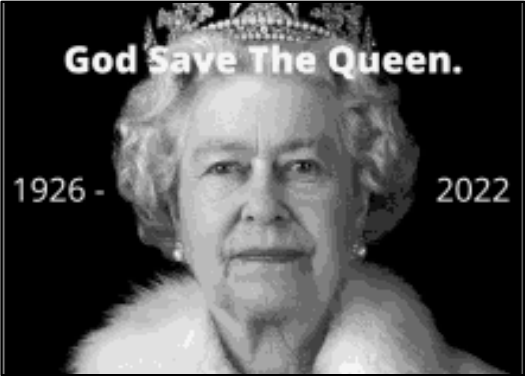
(Available in: https://tenor.com/pt-BR/search/god-save-the-queen-gifs. Acess in: August 2024.)
The usage of a present subjunctive.
An imperative by issuing a command.
Employment of a subordinate clause.
An affirmative in the indicative mood.
In analyzing the assertions about verbs, it can be stated that:
I- ‘Can’ (line 19) is a modal verb with the meaning of possibility;
II- ‘Has detected’ (line 10) is a Simple present verbal tense example;
III-‘has had’ (line 22) is part of Past Perfect verbal tense;
IV- ‘Oozed out of’ (line 27) is a phrasal verb;
III is incorrect.
II and III are incorrect.
IV is incorrect.
I and III are incorrect.
I and II are incorrect.
The verb form in “the NLG’s pedagogy of multiliteracies was conceived” (4th paragraph) is in the
simple past, active voice.
simple past, passive voice.
simple present, active voice.
present perfect, active voice.
simple present, passive voice.
Considering the collocations with “do” or “make”, mark the incorrect option.
She got an A on the test. She made well on it.
Don’t make any noise. The baby’s asleep.
Do me a favor and hand me that towel.
You can have some more tea. It won’t do any harm.
If you make a promise, you’ve got to practice what you preach.
I’m really sorry about not ...................... the dog to the vet. I didn’t think the problem was that serious.
take
taken
took
taking
Read the text:
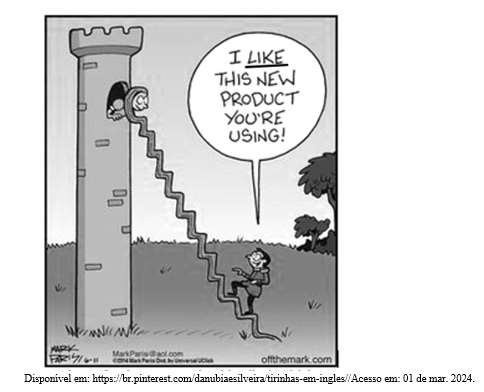
According to the comic above, the word in bold refers to:
nouns
verb
Possessive Pronoun
prepositions
Identify the mood of the verb in the sentence "I will, whether I’m a few steps or a few miles into my walk, admonish them — loudly and none too gently."
Indicative.
Imperative.
Subjunctive.
Conditional.
Infinitive.
Which option correctly identifies the verb tense used in the following sentence from the extract?
"I’ve had those two days to recharge my batteries".
Present tense
Past tense
Present perfect tense
Present continuous tense
Choose the alternative that indicates, correctly and respectively, a regular verb and an irregular verb.
Have; need.
Blame; use.
Feel; choose.
Want; make.
Which option completes the sentence below correctly?
After ____________ an ankle injury, the runner won a gold medal.
getting over
staying up
switching on
eating out
writing down
Verb forms help us to make time reference through their tense. Tense shows whether an action or a state took, take or will take place. For example, the simple past tense is used to express actions that have already happened; the simple present tense is used to express an action that is taking place or happening now; and, the simple future tense is used to express an action which will certainly take place at a time later than now. With that in mind, check the answer whose information provided is the only one correct about simple tenses sentences structure and verb conjugation.
Regular verbs in the Simple Past must be learned by heart or memorized through a list, whether they are conjugated in the singular or in the plural.
Verbs in the Simple Future are conjugated by adding “will” before the bare infinitive or base form of a verb, which is the infinitive without “to”.
Verbs in the Simple Present are conjugated by adding “-s, -es or -ies” to the bare infinitive or the base form of a verb (infinitive without “to”) whenever it is being conjugated in the plural.
Irregular verbs in the Simple Past are conjugated by adding “-d, -ed or -ied” to the bare infinitive or base form of a verb (infinitive without “to”), whether it is being conjugated in the singular or in the plural.
The negative form of verbs in the Simple Present are made of the auxiliary verb “did” and the negative adverb “not” as the negative form of verbs in the Simple Past are made of “do not” or “does not” written before the bare infinitive or base form of a verb.
In the second panel, there are examples of four different verb tenses.
Certo
Errado
Consider the following sentence: "By the end of this month, ________________ English for ten years." Which one of the following tenses should be used?
I have been teaching
I will teach
I will have been teaching
I am teaching
I had been teaching
The verb reaches (line 4) is conjugated in the third person of the singular in the simple present and obeys the same spelling rule as the verbs: to watch; to catch; and to wash.
Certo
Errado
Which word best substitutes the verb “leverage” in 4º§?
Enjoy.
Create.
Exploit.
Influence.
Mark the INCORRECT sentence, considering noun + verb form combination.
There is very little traffic at this hour.
The outskirts of the city are beautiful, you should visit.
I highly recommend the hotel! The staff is very efficient.
A useful piece of advice is to get a weekly pass.
The cabin crew are offering blankets, would you like one?
Choose the word or phrase that best completes the sentence:
Lisa ___________ she would be late for our meeting.
She _____________ she was not feeling well.
Told that / said that
Told that / said me that
Told me that / said that
Told me that / said me that
Told me that/ told
Read the excerpt below from Text I and choose the correct answer.
“That figure rose to 41% among millennials, who are usually defined as those born between 1981 and 1996."
What is the past participle form of the verb “rose”?
Rinsed.
Risen.
Raised.
Rosen.
Identify the correct past tense form of the verb "to eat" in the following sentence:
The children _______ all their sandwiches before going to play.
ate
eaten
eats
eating
eat



