





Seu próximo nível começa aqui
Com a Assinatura Ilimitada, você tem tudo que precisa para sua aprovação.
Com a Assinatura Ilimitada, você combina prática, teoria e método em uma única assinatura com tudo que você precisa para sua aprovação.
Select the sentence in which the possessive pronoun is used correctly.
That house is their.
This decision is my.
The blue backpack is hers.
Those seats are our.
The fault was yours one.
Examine a função sintático-semântica dos pronomes possessivos no inglês. Diferentemente dos adjetivos possessivos (my, your), os pronomes possessivos (mine, yours) exercem uma função substantiva. Analise a frase: "The error was not yours to make, but it quickly became mine to fix." No contexto apresentado, o uso de mine justifica-se por:
Modificar diretamente o substantivo fix, agindo como um determinante de posse em posição atributiva.
Substituir uma estrutura preposicionada que exigiria o uso obrigatório do artigo definido "the".
Evitar a repetição do núcleo nominal e atuar como complemento ou sujeito da oração, carregando em si a carga referencial do objeto possuído.
Indicar uma ênfase reflexiva, funcionando como um sinônimo exato da expressão by myself.
In the sentence "The exercise involves spending a few moments in the evening reflecting on your day," what is the function of "your"?
It is a possessive pronoun.
It is a object pronoun.
It is a possessive adjective.
It is a demonstrative pronoun.
It is a subject pronoun.
Mark the alternative that correctly and respectively fills in the blanks in the text:
I – them – them
my – they – their
me – they – them
me – their – they
Select the option that properly expresses possession:
“The childrens books were scattered everywhere.”
“The book’s child pages seemed torn.”
“The child of the book is well illustrated.”
“The child’s book was missing from the shelf.”
Qual alternativa apresenta o uso correto do pronome possessivo?
This is mine book.
Yours house is beautiful.
The dog wagged its tail.
That car is their.
Choose the correct possessive pronoun to correctly complete the following sentence:
"This old book is _______. I got it from my grandmother."
my
mine
me
I
mine's
Judge the sentences below.
I. Jenny missed hers flight yesterday.
II. They developed a program computer that sets it’s own security routine.
III. Gabriel, is this book yours?
The sentence(s) that indicate(s) the correct use of possessive adjectives or/and possessive pronouns is/are:
only I and II.
only I and III.
only II and III.
only III.
Choose the correct use the possessive cases.
The speech of the Pope - The speech Pope’s.
The farmer of those men - Those men’s farm.
The teeth of the baby - The teeth baby’s.
The books of the student - The books students’.
Read the following passage:
- Which T-shirt is yours? The pink one or the black one?
- The black is _______, of course, and the pink is ________. Did you forget?
Which possessive pronouns should be used to properly fill in the blanks in the passage?
ours, theirs
mine, yours
yours, his
mine, his
As regards possessive adjectives and possessive pronouns, fill in the gaps in the sentences below by choosing one of the two options in parenthesis.
A - Is that notebook _______ (your/yours)?
B - I encountered _____ (his/theirs) sister at the park last Sunday, can you believe it?
C - Has Lucy seen ___ (my/mine) coat?
In the order presented, the gaps are correctly and respectively filled by:
Yours; theirs; mine.
Your; theirs; my.
Yours; his; my.
Your; theirs; mine.
Yours; his; mine.
In terms of the use of possessives, which sentence is wrong?
I lent him my pen, but he forgot to return it.
Emma is playing with his toys.
The company is expanding its market.
Our team won the championship game.
Considering the first paragraph of the text, choose the correct alternative that presents the correct grammar association.
The verbs “refers”, “protect” and “prevents” are in the third‑person singular present tense form.
The word “computer” is a false cognate.
The adjective “common” is being used to compare two things.
“against”, “from” and “into” are examples of prepositions.
The word “it” is a possessive pronoun.
Choose the alternative in which there is, correctly and respectively the bold words:
“The blue car is hers and the red car is ours,”
Possessive adjective, Possessive adjective
Possessive pronoun, Possessive pronoun
Possessive pronoun, Possessive adjective
Possessive adjective, Possessive pronoun
Possessive pronoun, Object pronoun
Consider the sentence below:
"Today, I'm making a meat loaf for my uncle."
Which pronoun can substitute the underlined words in the sentence above?
Him.
His.
Us.
Them.
Read the text:
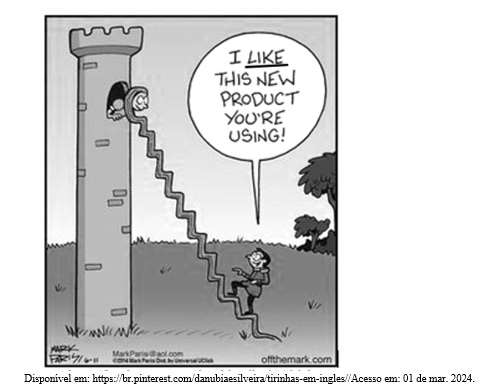
According to the comic above, the word in bold refers to:
nouns
verb
Possessive Pronoun
prepositions
Assinale a alternativa que completa a lacuna corretamente:
Peter brought his dogs and I brought_________
my
your
mine
the mine
The possessive determiner in “changing in its international uses” (3rd paragraph) refers to
EFL.
world.
English.
research.
compilation.
Read the following passage:
'Sally's cat is very playful. It loves to chase after ____ tail and play with ____ toys. ____ bed is soft and comfortable, and it always sleeps in it at night.'
From the passage, identify the appropriate possessive pronouns to complete the sentences, indicating ownership and relationship with the nouns. Which possessive pronouns should be used to properly fill in the blanks in the passage?
its, its, its
his, her, their
his, their, its
her, its, its
their, its, his
Pronouns substitute the noun in a paragraph or in a piece of writing to avoid repetition of the noun. Pronouns can be used in singular and plural forms as the verb written in the sentence should be used in accordance with the particular form of the specific pronoun. It is noteworthy that pronouns have different forms for the different ways they are used. A different pronoun is required depending on two elements: the noun being replaced and the function the noun has in the sentence. That being said, check the alternative that provides correct information about the correct use of the pronouns in English.
Personal pronouns are those pronouns that receive the action in a sentence. Any noun receiving an action in the sentence is a personal pronoun, therefore being categorized as an objective case.
Object pronouns are those pronouns used as a simple substitute for the proper name of a person. An object pronoun is a pronoun typically used to refer to a speaker or to the people or things that a speaker is referring to. Object pronouns are usually related to the subject of a sentence, who is the doer of an action.
Possessive pronouns are pronouns that modify a noun by identifying who has ownership or possession of it. Possessive pronouns express who owns or “possesses” something while always being used in front of a noun, for they are never used to replace nouns.
E. Demonstrative pronouns simply refer to nouns that are unknown or undefined in a sentence, for they are used to connect an independent clause to a relative clause.
Reflexive pronouns are used for the object of a verb when it refers to the same noun as the subject of that verb. It means that, by using a reflexive pronoun, one’s intention is to convey that the subject and the object of a sentence are the same.