





Seu próximo nível começa aqui
Com a Assinatura Ilimitada, você tem tudo que precisa para sua aprovação.
Com a Assinatura Ilimitada, você combina prática, teoria e método em uma única assinatura com tudo que você precisa para sua aprovação.
Text 6 (for question 37)
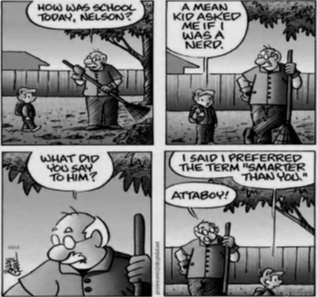
In: Pickles Comic Hub, by Brian Crane.
Disponível em: https://www.facebook.com/groups/1609193636291426/posts/ Acesso em jan. 2026
No último quadro do cartum, percebe-se, na resposta dada por Nelson (the little boy), o uso de uma estrutura linguística que expressa
admiração.
comparação.
concordância.
exagero.
modalização.
Syntactic complexity in English is achieved through coordination and subordination, with specific focus on the distinction between restrictive and non-restrictive relative clauses. Based on the rules of punctuation and the use of relative pronouns in formal English, choose the CORRECT alternative.
The researchers, who ignored the safety protocols were dismissed, while the equipment that was extremely expensive remained intact.
The researchers who ignored the safety protocols were dismissed, while the equipment which was extremely expensive remained intact.
The researchers, who ignored the safety protocols, were dismissed, while the equipment which was extremely expensive remained intact.
The researchers who ignored the safety protocols were dismissed, while the equipment, which was extremely expensive, remained intact.
The statement in which there is ellipsis of the subject is:
Bob ate the cake and drank coffee.
Cathy must wash the dishes and Bob clean his room.
Mary was given a doll and Peter a football.
I play volleyball for my school and Tom for his club.
Mark should be home at 10:00 and Jane at 11:00.
Considering the sentences extracted directly from the text "What you need to know about education and why it matters," analyze the alternatives below and identify the one that contains a subordinate clause.
Education enables individuals to develop the knowledge, skills and confidence needed to participate fully in society.
In 1950, only around 47 per cent of the world's children aged 5?14 were enrolled in school.
It is a cornerstone of peace, justice, and resilience in the face of today's most pressing global challenges.
UNESCO estimates that to achieve education for all by 2030, a child must enrol in school every two seconds from now on.
In the sentence “He created the YouTube channel Siesta Dog TV which features videos of dogs” (l. 05–06), the clause introduced by the underlined word
adds extra information about the channel.
identifies which dog Luna prefers.
expresses a contrast with the previous idea.
indicates the cause of Carano’s decision.
Identify the type of syntactic construction used in the following sentence from the book The Picture of Dorian Gray, by Oscar Wilde (1890):
"There are only two kinds of people who are really fascinating: people who know absolutely everything, and people who know absolutely nothing".
Polysyndeton.
Inversion.
Passive voice.
Antithesis.
Ellipsis.
English syntax is predominantly characterized by the Subject-Verb-Object (SVO) order, but certain structures allow for inversion to create emphasis. Mark the CORRECT alternative.
In interrogative structures where the "Wh-word" functions as the subject of the clause, the use of the auxiliary "do/does/did" is mandatory to maintain syntactic stability.
The standard order of adjectives in a noun phrase dictates that fact-based descriptors, such as color and material, must always precede opinion-based adjectives.
Negative or restrictive adverbs such as "seldom", "never", and "hardly" trigger subject-auxiliary inversion when placed at the beginning of a sentence for rhetorical emphasis.
Cleft sentences starting with "It" (It-clefts) are primarily used to emphasize the verb phrase of the action, moving the main verb to the initial position of the sentence.
Read the following quote, taken from paragraph 05 of the text, then analyze the statements about it.
“I always joke that books are not made of glass”
I. ‘I’ is a subject pronoun.
II. The sentence is written in Present Perfect.
III. ‘always’ is an adverb of frequency.
IV. ‘books are not made of glass’ is an example of Passive Voice.
Which statements are completely accurate?
I and II, only.
I and III, only.
III and IV, only.
I, II and III, only.
I, III and IV, only.
Adjuncts are often categorized by their function and their degree of integration into the clause structure. According to the classification proposed by Quirk et al., examine the function of the underlined word in the sentence: "Frankly, the results of the survey were quite disappointing."
The element "Frankly" is functioning as a:
Predication Adjunct.
Sentence Adjunct (Viewpoint).
Style Disjunct.
Conjunct.
The syntax of English is predominantly fixed, but certain structures allow for the repositioning of constituents to create emphasis or stylistic variation. Concerning sentence structure and inversion, mark the CORRECT alternative.
The standard order of adjectives before a noun dictates that fact-based adjectives, such as color and origin, must always precede opinion-based adjectives to avoid semantic ambiguity in formal descriptions.
The positioning of indirect objects must occur after the direct object, necessarily followed by the preposition "to" or "for," regardless of whether the indirect object is a pronoun or a long noun phrase.
Subject-auxiliary inversion is mandatory after negative or restrictive adverbial expressions like "seldom," "never," or "under no circumstances" when they are placed at the beginning of a sentence for emphasis.
Cleft sentences starting with "It" (It-clefts) are used to emphasize the verb of the action, moving the verbal phrase to the initial position while the subject is placed at the end of the relative clause.
In exclamatory sentences starting with "Here" or "There," subject-verb inversion occurs only when the subject is a personal pronoun, ensuring that the focal point of the sentence remains at the end of the phrase.
Consider the structure of complex sentences and the use of relative clauses in English. Analyze the following statements:
I.Defining relative clauses provide essential information about the noun they modify and are never separated from the rest of the sentence by commas.
II.Non-defining relative clauses provide extra information and must be enclosed in commas, but the relative pronoun "that" cannot be used in these structures.
III.In informal English, it is grammatically incorrect to end a sentence with a preposition, even in relative clauses where the pronoun is omitted.
Which of the statements above is/are CORRECT?
I, II, and III.
I and II only.
II only.
III only
The underlined verb phrase in "The team compiling the dictionary say that [...]" correctly agrees with the subject. This does NOT happen in:
He is one of the best doctors who have worked here.
Ten miles is a long way to run even if I'm not tired.
The young has been under pressure suffering from anxiety.
A couple of passengers were frightened because of turbulence.
Half of the victims intend to sue the company after the accident.
In sentence organization, subordinate clauses may establish semantic dependency and contribute to textual articulation in formal and informal discourse. Teachers frequently analyze how clause relations affect coherence, emphasis, and logical progression in written communication. Considering adverbial clauses in English syntax, identify the correct statement:
Adverbial clauses may determine plural marking through nominal agreement relations.
Adverbial clauses may establish phonological reduction through articulatory simplification.
Adverbial clauses may indicate lexical borrowing through semantic approximation patterns.
Adverbial clauses may express relations such as cause, contrast, or condition.
Adverbial clauses may organize syllabic prominence through rhythmic distribution patterns.
O excerto do texto “CLT does not exclude a focus on metalinguistic awareness or knowledge of rules of syntax, discourse, and social appropriateness” traz à tona a importância da sintaxe. Assinale a alternativa cuja sintaxe gera ambiguidade.
Children filled the park with happy sounds.
The old men and women left the room.
Passengers were welcomed by the crew.
It is usually hard to make decisions under pressure.
Not much remained intact after the hurricane passed.
A sintaxe inglesa permite a inversão do sujeito e do auxiliar (Subject-Auxiliary Inversion) em contextos específicos para fins de ênfase, formalidade ou coesão textual. Considerando as regras de inversão após advérbios negativos ou restritivos em posição inicial na frase, assinale a alternativa que apresenta a estrutura sintática correta.
Under no circumstances the students should be allowed to leave the room without permission.
Hardly had I arrived at the station than the train left.
Not only did he miss the deadline, but he also refused to apologize to the team.
Rarely I have seen such a remarkable display of dedication in a classroom environment.
Analyze the sentence: 'Although the research was comprehensive, the results were inconclusive, so further study is required.' Select the option that correctly classifies the clauses and their relationships.
It is a simple sentence with a compound subject and predicate.
It contains a subordinate concessive clause, followed by a main clause coordinated with a result clause.
It consists of three independent clauses linked by coordinating conjunctions.
The clause 'so further study is required' is a subordinate clause of purpose.
In the first two paragraphs, the pair of terms whose meanings are in evident contrast is:
seemed – appeared.
endowed with – lacked.
considerably – markedly.
traits – characteristics.
attacks – procedures.
The word “who” in “Taking the reins from Jimmy Kimmel, who oversaw proceedings in 2023 and 2024, will be the beloved comedian Conan O’Brien” (l. 22–23) introduces a(an):
Independent clause.
Adverb clause.
Coordinate clause.
Relative clause.
Noun clause.
O verbo “do” pode atuar em uma oração ou frase como verbo auxiliar ou principal.
Assinale a alternativa em que “do” assume a mesma função daquela que desempenha na frase do segundo parágrafo “We set out to understand how much agency children have in their education, and what difference it makes when they do.”
We don’t really get to choose what we do in the lessons at school.
My grandparents are greatly limited, but feel so happy when there’s a favor they can do!
I don’t know what’s happened to me; everything that I do turns out badly
We’re not always able to prevent the damage floods and storms can do.
The two boys like to play dirty jokes: this is what they do when people are not looking.
"The first level, signs, encompasses the means of expression."
Em relação ao texto apresentado, qual das seguintes reestruturações desse trecho mantém o sentido original, manifesta ênfase semelhante e é gramaticalmente correta?
Signs, the first level, encompasses the means of expression.
The means of expression, the first level, encompasses signs.
Encompasses the means of expression, the first level, signs.
The first level encompasses the means of expression, signs.
Signs encompasses the means of expression, the first level.