




Seu próximo nível começa aqui
Com a Assinatura Ilimitada, você tem tudo que precisa para sua aprovação.
Com a Assinatura Ilimitada, você combina prática, teoria e método em uma única assinatura com tudo que você precisa para sua aprovação.
A teacher is preparing a lesson on relative clauses and wants to present students with examples that illustrate correct usage in everyday communication. During the lesson, the teacher writes several sentences on the board and asks students to identify the grammatically correct one according to standard English usage.
Considering the appropriate use of relative pronouns and their functions in defining clauses, choose the correct sentence:
The boy which is playing is my brother.
The boy who is playing is my brother.
The boy where is playing is my brother.
The boy whose is playing is my brother.
The boy whom is playing is my brother.
Taking into account the brazilian legal dispositions that refer to the teaching-learning of foreign languages, analyse and judge the assertions, as T (true) or F (false), to choose the compliant option.
( ) The English language will be offered from the 6th grade on.
( ) The study of foreign languages during the Educação Básica [Basic Education] will be discretionary.
( ) As to Ensino Médio [High School], students should have the choice among the mandatory languages according to availability.
( ) In the Ensino Médio [High School] syllabus, among elective languages, Spanish is preferential.
( ) Either English or Spanish will be the foreign language of choice, starting on the 6th grade.
T, T, T, F, T.
F, F, F, T, F.
F, T, T, F, T.
T, F, F, T, F.
A teaching approach emphasizes the use of reallife communication, encouraging students to interact in English through tasks such as discussions, role plays, and problem-solving activities. Students' motivation to learn comes from their desire to communicate in meaningful ways about meaningful topics. Grammar is explored within meaningful situations rather than through isolated drills.
Which teaching approach is best represented by this description?
Grammar-Translation Method
Direct Method
Communicative Language Teaching
Audio-Lingual Method
Reading Method
Na BNCC / Anos Finais do Ensino Fundamental (2017), o Inglês
I. é visto como uma Língua Franca, ou seja, como ferramenta de comunicação global; foca no desenvolvimento de habilidades e na comunicação de forma natural e autônoma.
II. deve ser ensinado com ênfase no conhecimento da gramática e do léxico – eixos estruturantes do currículo – para se adquirir uma autêntica competência comunicativa.
III. tem um dos principais focos no multiletramento, ou seja, no desenvolvimento de múltiplas formas de ler e produzir textos, usando diversas tecnologias e linguagens.
IV. tem forte base metodológica nas abordagens que valorizam a leitura de textos clássicos, a tradução e a gramática – tripé do ensino-aprendizagem de línguas estrangeiras.
Estão CORRETAS apenas
I e III.
II e IV.
I, II e IV.
III e IV.
I e II.
Consider the following paragraph, by the author Holger Pötzsch (2019):
"Fresh funds for new devices, in the long run, implies less funding for traditional activities (...). What is often lacking is a critical debate about the actual need for and overall long-term costs of new technologies, about possible alternatives, and about the global human and ecological implications of these large-scale investments in high-tech equipment and the significant resources they require. (...) The demand for new skill sets for teachers or the inclusion of new subjects to be taught such as informatics or programming imply a cutting of teaching hours and content in different areas".
Which of the following aspects of foreign language teaching methodologies are exemplified in the sentence?
Digital technology use and digital literacy.
Flipped Classroom and digital literacy.
Blended learning and teacher-centered classroom.
Inquiry-Based Learning and Cohesion.
Digital technology use and gamification.
Developing intercultural communicative competence has become an important goal of foreign language education, because it means developing knowledge, skills and attitudes that can facilitate the understanding of one's culture and the culture of the other. Thus, dialogue and exchange are key words for both students and teachers.
In this regard, which alternative presents good pedagogical tools focused on such competence in the English language classroom?
Conversation clubs, independent text production and silent reading.
Peer feedback, grammar exercises and role-plays.
Independent text production, grammar exercises and comparative cultural practices discussion.
Conversation clubs, comparative cultural practices discussion and exercises to help standardize accents.
Peer feedback, role-plays and comparative cultural practices discussion.
No contexto das novas tecnologias de comunicação, o ensino de Inglês deve considerar que:
a linguagem digital empobrece a competência linguística.
o inglês escrito e falado se mantém rigidamente separados.
práticas multimodais ampliam os letramentos contemporâneos.
gêneros digitais não possuem valor pedagógico.
When teaching complex grammatical structures such as the Causative form (have/get something done), teachers must address both the syntactic arrangement and the semantic implication of agency. Choose the alternative that correctly describes the semantic nuance of the causative in "She had her roof repaired".
The subject (She) arranged for the action to be performed by a third party (agent), emphasizing the result rather than the agent itself, who is often omitted.
The sentence is grammatically equivalent to "She repaired her roof", with the causative form serving merely as a formal stylistic variation without semantic change.
The subject (She) performed the action of repairing the roof herself, but the structure implies that it was a difficult task completed with effort.
The structure implies that the subject (She) was coerced or forced into repairing the roof against her will by an external authority.
During an oral assessment, the teacher uses a rubric with criteria such as fluency, accuracy, pronunciation and interaction. This practice is an example of:
Holistic scoring of written texts.
Discrete-point testing of vocabulary.
Multiple-choice testing of grammar.
True/false comprehension checking.
Analytic rating of speaking performance.
A teacher asks students to write an email to a friend, following a model text and focusing on greeting, body and closing. This writing approach is best described as:
Translation-based.
Dictation-based.
Audiolingual.
Lexical-based.
Genre-based.
Analise a imagem a seguir.
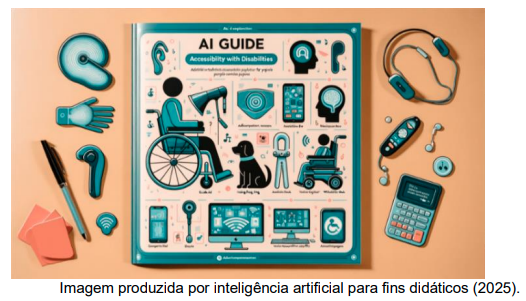
Com base na imagem, recursos tecnológicos utilizados no ensino inclusivo de Língua Inglesa podem
limitar a participação dos estudantes ao uso de equipamentos específicos, reduzindo a variedade de estratégias pedagógicas.
substituir completamente a mediação docente, tornando desnecessárias adaptações curriculares voltadas a estudantes com deficiência.
diversificar formas de acesso aos conteúdos, oferecendo alternativas visuais, auditivas e motoras que favorecem a aprendizagem de diferentes perfis de alunos.
concentrar o processo de aprendizagem apenas em dispositivos eletrônicos, afastando o aluno das práticas colaborativas em sala de aula.
Reading comprehension in a foreign language involves identifying not only the literal meaning but also the illocutionary force behind specific statements.
Considering the strategies for processing complex academic texts in English, mark the CORRECT alternative.
Skimming is a technique used primarily for locating specific dates or technical terms within a paragraph, requiring a detailed analysis of every sentence to ensure that no minor grammatical detail is overlooked by the reader.
Critical reading requires the ability to identify the author's underlying assumptions and the socio-historical context of the production, moving beyond simple decoding to understand how ideological biases may influence the information presented.
A text is considered inherently coherent if it contains a high frequency of coordinate conjunctions, regardless of whether the propositions establish a logical relationship or if the reader possesses the necessary prior knowledge.
The process of translating a literary text from English to Portuguese should prioritize a word-for-word literal substitution, as this is the most effective way to preserve the original prosody and cultural nuances of the source.
You, an English teacher, decided to use the article “Underground library in Warsaw metro invites commuters to trade scrolling for stories” to practice speaking with your students. After studying the text, you give them some questions about reading habits, so they can ask their friends and interact while you observe. If you want to do this activity from a sociocultural approach, you have to prioritize
the grammar structures they are using.
their opinions on reading and libraries.
their ability to memorize different parts of the article.
if they know the correct pronunciation of the words they are using.
if they are able to interact with each other, share ideas and values.
You, an English teacher, decided to use the article “Underground library in Warsaw metro invites commuters to trade scrolling for stories” in the classroom with your students. While you are studying the text with them, reading, asking questions and doing some exercises, you are also evaluating them. You ask yourself, about each student, the following questions:
- Is the student paying attention to the class?
- Is the student joining the discussions we are doing during the class?
- Is the student doing the exercises, written or spoken?
- Is the student reading the text aloud, in silence during the class or as homework, depending on what was asked?
The questions help you evaluate the students, considering their participation during the classes and not only the grades they get on the tests. You could say that you are performing what kind of assessment?
Diagnostic assessment.
Formative assessment.
Summative assessment.
Pre-test assessment.
Accountability assessment.
No Ensino de Línguas Baseado em Tarefas (Task-Based Language Teaching - TBLT), a aula é estruturada fundamentalmente em torno de:
Exercícios de repetição mecânica (drills) para fixação de padrões fonéticos e sintáticos.
Aulas expositivas sobre a história da língua inglesa e a literatura de países anglófonos.
Atividades de tradução literal de sentenças isoladas do inglês para o português.
Uma tarefa central que os alunos devem realizar usando a língua alvo para alcançar um resultado comunicativo e não puramente linguístico.
Study the affirmatives below about Language and English Language Teaching, focusing on conceptions of language, language as a social practice, and communicative competences.
1. Writing in English is limited to producing grammatically correct sentences, without considering purpose or audience.
2. Language can be understood only as a system of grammatical rules, independent of social context.
3. Effective English language teaching encourages meaningful communication and real-life language use.
4. The concept of language as a social practice emphasizes interaction, meaning-making, and context.
5. Oral comprehension (listening) is developed only through explicit grammar instruction.
Choose the alternative which presents the correct affirmatives.
Affirmatives 1 and 3 are correct.
Affirmatives 2 and 3 are correct.
Affirmatives 2 and 5 are correct.
Affirmatives 3 and 4 are correct.
Affirmatives 4 and 5 are correct.
The linguistic aspects of the English language refer to the main components that describe how English is structured, used, and understood.
Decide if the following affirmatives about the linguistic aspects of the English language are true ( T ) or false ( F ).
( ) Teaching vocabulary in isolation, without context, generally promotes deeper communicative competence.
( ) Phonetics is concerned with the physical production and perception of speech sounds, while phonology studies how these sounds function within a language system.
( ) Semantics and pragmatics are closely related, but pragmatics focuses more on meaning in real communicative situations.
( ) Vocabulary knowledge includes only knowing word meanings but also understanding collocations, register, and usage.
( ) English has a relatively fixed word order, which makes syntax an important aspect for meaning construction.
Choose the alternative which presents the correct sequence, from top to bottom.
T • F • T • F • T
T • F • F • T • F
F • T • T • F • F
F • T • T • F • T
F • T • F • T • T
Text I
African schools gear up for the AI revolution
1 The emergence of cheap or free AI tools is being eagerly embraced by those with smartphones and the ability to get online. As governments and legislators struggle to get their heads around the implications of this powerful technology and work out how to bring in regulations for its safe use, millions of people are enjoying its ability to save time, helping them to transforming raw data into essays, exam answers, or, with a bit more work, even videos and podcasts.
2 Even in developing countries where electricity and internet access is limited (it’s estimated that over 570 million people in Africa lack electricity), there is enthusiasm for the potential of AI. In the Democratic Republic of the Congo (DRC), for example, a nation riven by internal conflict, poverty and vast inequality, educators are seeing the impact of AI. “It is obvious that our country is lagging behind in terms of new technologies for one reason or another,” says Benjamin Sivanzire, a teacher in Beni, North Kivu Province. “Many parts of the DRC do not even have traditional methods of communication, or even radio or television.” However, even though Mr. Sivanzire and his students are not yet able to make use of AI in their classes, they are seeing it being used in the wider culture, often in a negative way, to manipulate public opinion. The teacher underlines the importance of educating people to distinguish between verifiable information and lies. “There are videos created by artificial intelligence that show images that are not real and have been created for propaganda purposes,” he explains.
3 One concern that is frequently raised is the extent to which the development of AI tools is concentrated in the hands of a relatively small group of people. Farida Shahid, the independent Special Rapporteur on the right to education, shares these concerns. “AI algorithms are being made by individuals who often sit in a particular location, such as Silicon Valley, where the people who make and test them have their own biases,” she says. “Often the algorithms don’t do well at recognizing people with dark skin. They also have great problems with people who are autistic and don’t like looking into cameras. “Another example is the UK where, recently, an AI program was used to grade exam papers. This led to decisions that were biased against people from certain ethnic backgrounds. We really need to look at this issue more closely, starting with the human rights perspective, and I think that’s where the U.N. role comes in: if you increasingly rely on AI as the source of verification, you’re going to have problems because you are using a framework which privileges white males, and doesn’t reflect the whole gamut of people’s lives and experiences”.
4 The urgent need to expand the developer talent base has been identified by the UN as central to ensuring that a wide variety of voices are heard in the “EdTech” (educational technology) space. Shafika Isaacs, the head of technology and AI at the UN agency for science, technology and education (UNESCO), says that the number of African EdTech startups has been mushrooming in recent years, with entrepreneurs experimenting with the AIenabled digital tools which could support learning and teaching across many different contexts, including in African languages, and local dialects. “I’ve personally engaged with a startup that matches high school students to career pathways, including choosing the right university, community college or even entrepreneurship program. They have seen strong results because of their focus on children in underprivileged contexts and schools. Tech startups have also looked at developing AI-enabled mobile apps, including chat bots, that can support teachers in teaching literacy or teaching mathematics. “The challenge is that there’s often a disconnect between the public education system and tech startups. We need educators to be proactive in engaging with those developing tools, and we encourage students and teachers to learn how to create and design technologies that are relevant to their linguistic and cultural contexts.”
5 Many African governments are keen to adopt national AI strategies and integrate AI into their national policies on technologies in education. In Côte d’Ivoire, where AI is already being widely used in the private sector, Mariatou Koné, the Minister of Education, says that the country’s education system is undergoing a transformation, following a 2022 review which recommended a digitalization strategy. “We have put in place initiatives to ensure that everyone is aware of the issue of AI. It can provide individual learning programs, and help struggling students to improve,” said Ms. Koné. “However, we are worried about potential abuses. We have to be able to protect personal data and ensure that learners are aware of the potential dangers.” The Minister agrees that, in order to guard against bias, the pool of engineers building AI tools needs to be expanded. “We need the right tools, adapted to the African context, to the Ivorian context. We have our own history, our own heritage. If we create our own industry, it has to be adapted to the realities of Côte d’Ivoire.”
Available at: https://news.un.org/en/story/2025/01/1159621. Retrieved on: January 6, 2026. Adapted.
In a Brazilian high school English classroom, a teacher decides to move away from using text as a pretext for teaching grammar and instead adopts a genre-based approach to teach students how to write research abstracts or digital social media profiles.
The pedagogical strategy that adequately applies this approach is
focusing exclusively on the internal linguistic patterns and rhetorical structures (text types), such as the use of the past tense or passive voice, while ignoring the external criteria and social purposes recognized by the speech community.
selecting a popular comic strip as the primary reading material and using it to have students identify coordinate conjunctions, thereby ensuring the text remains a set of technical skills regardless of its social or political contexts.
providing students with a list of grammar rules to ensure they maintain an L2-only orientation, forbidding any use of the mother tongue to explain complex abstract vocabulary during the writing process.
assuming that because the students are digital natives, they will inherently understand how to navigate digital genres like blogs or interactive posters without the need for scaffolding or explicit instruction on genre organization and features.
utilizing a teaching-learning cycle that includes modelling, joint construction, and independent construction, guiding students to understand that genres are staged, goal-oriented social processes intended to achieve specific communicative purposes.
The statement that best describes the difference between a traditional formalist/structuralist approach and a functionalist/ concept-oriented approach to ESL/ELF syllabus design and classroom exercises is:
A formalist view focuses on the social and political functions of language to foster critical citizenship and active agency, while a functionalist view treats language as an innate organ of the mind that operates through deduction from built-in knowledge, entirely independent of the learner’s communicative needs or social environment.
A formalist approach identifies a specific concept or meaning (e.g., futurity) and investigates all the ways it is expressed through lexical and morphological devices, whereas a functionalist approach insists on a native-speaker only policy and forbids any focus on meaning until a codified, standard variety of the target language is mastered through silent reading.
Formalist exercises use structure-trapping tasks to ensure that meaning is always secondary to the description of the language’s internal linguistic patterns, while functionalist exercises typically prioritize audio-lingual drills and massive repetition to ensure that stimulus-response associations are strengthened before errors can become bad habits.
Formalist syllabuses are designed to be flexible and retrospective, emerging only after classroom interaction has occurred, whereas functionalist syllabuses rely on linguistic grading to produce simplified, doctored texts that ensure learners never encounter language slightly beyond their current level of knowledge.
A formalist approach builds synthetic syllabuses that present language as a finite set of predictable building blocks, such as discrete grammatical rules or phonemes, in a linear sequence for the learner to reassemble, while a functionalist approach utilizes analytic syllabuses organized around meaningful tasks where learners must navigate the communicative utility of various linguistic resources to express specific concepts like time or space.
Translanguaging facilitates decoloniality in contemporary language education by
challenging the structuralist view of languages as separate, autonomous codes and validating the lived heritage of marginalized groups as legitimate knowledge.
serving as a temporary interlanguage bridge that helps students move from their home variety toward the mastery of the pure, standard norms of a named language.
encouraging students to strictly separate their diverse linguistic resources in the classroom to prevent the contamination of academic registers by local dialects or colloquial forms.
providing a purely descriptive label for the non-conventional practices and accidental errors made by bilingual students when they lack proficiency in the target language.
implementing a parallel monolingualism approach that treats each language as a self-sufficient system to ensure that the social and political status of dominant languages is maintained.