







Seu próximo nível começa aqui
Com a Assinatura Ilimitada, você tem tudo que precisa para sua aprovação.
Com a Assinatura Ilimitada, você combina prática, teoria e método em uma única assinatura com tudo que você precisa para sua aprovação.
The Curricular Guidelines for High School (2006, p.87) propose new aims for Foreign Languages teaching.
Choose the item(s) that point(s) those new aims.
|. To revisit the reflection on the educational role of foreign language teaching in High School and emphasize its importance.
Il. To reaffirm the relevance of the notion of citizenship and discuss the practice of this concept in foreign language teaching.
III. To discuss the problem of exclusion in education in the face of "globalizing" values and the feeling of inclusion often associated with knowledge of foreign languages.
IV. To introduce theories on language (literacies, multiliteracies, multimodality, hypertext).
V. To provide suggestions for the practice of foreign language teaching through new technologies.
Choose the CORRECT alternative.
BRASIL. Ministério da Educação: Secretaria de Educação Básica. Orientações Curriculares para o Ensino Médio: Linguagens, códigos e suas tecnologias. Brasília, 2006, p.87.
Only |, Ill and IV are true.
Only Il, Ill and V are true.
Only |, IV and V are true.
Ontly Il, Ill and IV are true.
All items are true.
“Teachers may wonder “which way they ought to go” before they enter a classroom. This usually means that teachers need to plan what they want to do in their classrooms. So, lesson planning involves decisions about the pedagogical dimensions of the lesson. But another important aspect of a lesson concerns the management of learners during the lesson. This includes eliciting students” attention, maintaining their engagement in the lesson, and organizing them into pairs or groups.” (Farrell, 2002, p.30)
After reading about the importance of lesson planning, match the CORRECT information to the number in the following Lesson Plan.
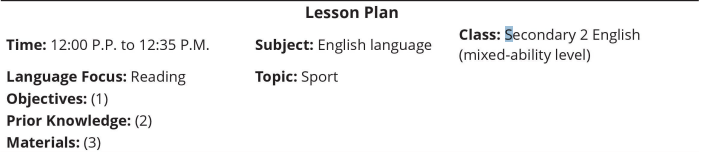
Step | Time | Tasks (Teacher) | Tasks (Pupils) | Interaction | Purpose |
1 | 5-10 mins | (4) | (5) | (6) | (7) |
( )1. Reading materials - article from a book on sports
2. Television
3. Whiteboard
( ) To teach the students how to skim for main idea of the passage - identify key words.
( ) Students have learned how to locate information by reading and finding the main sentence of each paragraph.
( ) Opening:
Introduction on the topic sports. T activates schema for sport.
T asks Ss to help him/her write down as many different kinds of sport on the whiteboard within 3 minutes.
( ) Listen
Ss call out the answer to the question as the T writes the answers on the board.
( ) Arouse interest. Activate schema for sport
( )T ↔ Ss
Choose the CORRECT sequence.
FARRELL, T. S. C. Lesson Planning In: RICHARDS, J. C. & RENANDYA. W.A. Methodology in Language Teaching: an Anthology of Current Practice. Cambridge: Cambridge University Press 2002. Chapter 3 - pages 30-39.
3-6-2-7-5-4-1.
3-1-2-4-5-7-6.
3-2-1-4-5-7-6.
3-1-2-4-7-5-6.
3-1-4-3-5-6-7.
In the methodology of "Positive Discipline" created by Jane Nelsen, the concept of "Logical Consequences" is frequently contrasted with "Punishment." For a consequence to be truly logical and educational rather than punitive in an English classroom setting, it must adhere to the "Four Rs" of Logical Consequences. Select the alternative that correctly identifies these four criteria.
Rigorous (it is severe enough to deter future misbehavior), Rapid (it is applied immediately), Relevant (it matters to the student), and Restricted (it isolates the student).
Related (the consequence is related to the behavior), Respectful (it is not enforced with blame or shame), Reasonable (it is not harsh), and Revealed (it is known in advance).
Retributive (it balances the scales of justice), Repeated (it is consistent), Recorded (it is documented), and Reinforced (it is backed by administration).
Real (it happens naturally), Rare (it is used sparingly), Rational (it makes sense to the teacher), and Righteous (it upholds moral values).
Restrictive (it limits freedom), Reactive (it responds to an event), Regulated (it follows school policy), and Remorseful (it makes the student feel sorry).
Norman Fairclough's Critical Discourse Analysis (CDA) serves as a powerful framework for teaching reading comprehension. One of the key concepts in CDA is "Synthetic Personalization." Select the alternative that correctly defines this phenomenon and its relevance to analyzing mass media texts in English.
It is a grammatical error where the writer fails to maintain a consistent narrative voice, switching between first and third person randomly within the text.
It is the practice of students writing autobiographies in English class to synthesize their personal experiences with the grammar rules learned.
It is the tendency of mass media and advertising to address a large, anonymous audience as if they were individuals (using direct address "you", colloquial language, and simulated conversational tone) to create a false sense of intimacy and manufacture consent.
It describes the process where an author unconsciously projects their own personality traits onto the fictional characters of a novel, creating a synthesis of the self and the other.
It refers to the use of artificial intelligence to generate personalized texts for students based on their reading level, ensuring that the vocabulary is synthetically simplified.
Henry Giroux's concept of "Border Pedagogy" is essential for fostering critical citizenship in English Language Teaching (ELT). Regarding the implications of this concept for the English teacher, mark T for true and F for false statements:
(__)Border Pedagogy encourages students to cross the metaphorical borders of their own cultural and epistemological territories, recognizing that knowledge and power are related and that their own identities are constructed within specific historical contexts.
(__)The teacher's role is to act as a "border crosser," engaging with diverse cultural texts and enabling students to critically analyze the "codes" of the dominant culture while validating their own subordinate voices.
(__)Border Pedagogy advocates for the reinforcement of rigid national borders and the exclusive teaching of the standard variety of English to ensure the preservation of linguistic purity and national identity.
(__)It proposes that students should become "cultural tourists," observing other cultures passively without engaging in the political struggle over meaning or questioning the conditions of knowledge production.
After analysis, choose the alternative that presents the correct sequence of the items above, from top to bottom:
F, F, T, T.
T, T, F, F.
F, T, F, T.
T, T, T, F.
T, F, T, F.
Identifique abaixo as afirmativas verdadeiras ( V ) e falsas ( F ) acerca do tema “Base Curricular Municipal de Concórdia”.
( ) As diretrizes de inclusão, previstas na Base Curricular Municipal, prevê ações de inclusão e acessibilidade, articuladas à proposta pedagógica.
( ) A estrutura curricular da BCM/Concórdia integra a BNCC com os elementos da realidade local, incluindo a parte diversificada.
( ) A Educação em Tempo Integral no município de Concórdia dispensa a necessidade de planejamento pedagógico.
( ) Quanto ao uso de Tecnologias de Informação e Comunicação (TICs) na BCM/Concórdia é recomendado para substituir totalmente os materiais impressos.
Assinale a alternativa que indica a sequência correta, de cima para baixo.
F • F • V • V
F • V • F • F
V • F • F • F
V • F • F • V
V • V • F • F
A abordagem comunicativa (Communicative Language Teaching - CLT) revolucionou o ensino de línguas ao deslocar o foco da forma gramatical para a função comunicativa. Na prática pedagógica baseada nesta abordagem, a interação e o uso de materiais autênticos são fundamentais. Assinale a alternativa correta.
O papel do professor no Ensino de Língua Comunicativa (ELC) é o de único detentor do saber, devendo falar durante noventa por cento do tempo de aula para fornecer o modelo perfeito.
Nesta abordagem, o erro deve ser corrigido imediatamente pelo professor de forma punitiva para evitar que o aluno desenvolva hábitos linguísticos viciados.
Materiais autênticos, como notícias reais e cardápios, são proibidos nesta abordagem por serem considerados excessivamente complexos e desmotivadores para os iniciantes.
A prática pedagógica comunicativa baseia-se exclusivamente na repetição mecânica de diálogos pré-formatados, proibindo qualquer forma de expressão espontânea.
O ensino comunicativo de língua visa desenvolver o que Dell Hymes denominou competência comunicativa, integrando conhecimentos linguísticos, sociolinguísticos, discursivos e estratégicos.
Collocations are pairs or groups of words that habitually go together. Using the correct collocations makes the speaker sound more natural and fluent. Regarding the concept of word partnerships, identify the correct statement.
The phrase 'fast food' and 'quick meal' are interchangeable in all contexts, meaning 'quick food' is the most common way to describe a hamburger.
Collocations are random associations that vary from person to person, and there are no established patterns in the English language.
English learners should avoid using collocations and instead focus on using only long, complex words to impress their audience.
Adjectives and nouns do not form collocations, as only verbs can be associated with other parts of speech in a sentence.
In English, we say 'make a decision' rather than 'do a decision', demonstrating that certain verbs are restricted to specific noun phrases.
The integration of the four language skills is a hallmark of the communicative approach. Listening and speaking are often linked in conversational contexts, while reading and writing are associated with literacy. Regarding the relationship between these skills, identify the correct statement.
Listening comprehension is a passive process where the brain simply records sounds without making any active inferences or using contextual clues.
Writing is a purely mechanical skill that does not require any prior exposure to reading or understanding the conventions of a specific genre.
The development of speaking skills is completely independent of listening, as humans possess an innate 'speech-only' module in the temporal lobe.
Effective communication requires the ability to use both receptive and productive skills in an integrated manner to negotiate meaning in real-time interactions.
Reading is considered a productive skill because the reader produces sounds aloud while interpreting the symbols on the page.
READ THE TEXT AND ANSWER THE THREE QUESTIONS BELOW
Liberating Adult Education, Animation and People Centred Democracy
Marjorie Mbilinyi
Adopting Issa Shivji’s paradigm, “The philosopher in Nyerere was informed by, and in constant search for, human equality and freedom, while the king in him was driven by the imperatives of building a nation-state” [Shivji 2020 Book Three: 2]. Mwalimu Nyerere advocated transformative pedagogy and liberating adult education, which he linked to nation building and peoplecentred participatory development, especially at grassroots level. He argued that adult learners have knowledge to share. They need to be encouraged to think, analyse critically and act on their own behalf so as to improve their situation. They thereby became active subjects, and participated equally in making key decisions on resource allocations at all levels and benefited equally. While referring to individual demands for freedom and dignity, Mwalimu emphasized the collective nature of these demands, and argued that the African people can only realize real democracy and freedom by uniting together so as to fight against neo-colonialism and corporate globalisation and to struggle for equitable, just development and economic liberation. At the same time, he was a powerful ruler who established an Executive with no checks and balances and focused on nation building and African liberation, not socialism. He denounced global elites and Northern based imperialism, but in the early years he rarely took action against the growth of a bureaucratic bourgeoisie in his own state and party. The failure to translate his ideals of equality and justice into a popular mass movement of workers, peasants, students and others contributed to the ultimate downfall of ujamaa. At the same time, he succeeded in sustaining national unity in an increasingly hostile context during the 1980s debt crisis and confrontation with the International Monetary Fund (IMF) demands for Structural Adjustment (SAP) and neoliberalism [Shivji 2020 Book Thre.
Fonte: Mbilinyi, Marjorie. "Liberating Adult Education, Animation and People Centred Democracy." Convergence 44.1: 3-16.
Based on Marjorie Mbilinyi’s text, the concept of liberating adult education advocated by Mwalimu Nyerere is primarily characterized by:
The vertical transmission of technical knowledge aimed at accelerating economic modernization and consolidating African socialism.
The treatment of adult learners as passive recipients whose main role is to legitimate decisions previously defined by the State.
The subordination of adult education to the requirements imposed by international financial institutions, especially within Structural Adjustment Programs.
The integration of critical education, political participation, and nation-building, recognizing adults’ prior knowledge and encouraging collective action in favor of democracy and social justice.
In text 10A2-II, the author shows concerns about “YouTube Kids and artificial intelligence chatbots” and the feeling that worrying about “cartoons (...) may sound quaint”. Those concerns reflect a critical challenge for the contemporary English language teacher, which is
the shift towards teaching only American and British English, as these are the dominant linguistic variants used by artificial intelligence and streaming services.
the imperative to develop students' multiliteracies, enabling them to critically analyze, produce, and engage with diverse, multimodal texts and digital platforms in English.
the need to ban all digital devices from the classroom to ensure focus on traditional print literacy.
the necessity of adopting a purely structuralist approach to grammar, ignoring the cultural context of digital media.
the exclusive focus on the speaking skill, as digital media primarily enhances oral communication.
No planejamento de ensino, um objetivo geral como 'Aprender sobre a cultura britânica' é considerado mais eficaz do que um objetivo específico como 'Ao final da aula, o aluno será capaz de listar três feriados importantes do Reino Unido e descrever uma tradição associada a cada um', pois o primeiro permite maior flexibilidade ao professor.
Certo
Errado
Situação hipotética: Um aluno do 8º ano escreve a frase: 'You must to be quiet in the library.' Assertiva: A análise pedagógica do erro indica que o aluno utilizou incorretamente o verbo modal 'must' para expressar uma obrigação forte, devendo, nesse contexto, ter utilizado 'have to'.
Certo
Errado
Em uma aula de inglês baseada em tarefas (Task-Based Learning - TBL), cujo foco principal é a conclusão de uma tarefa comunicativa significativa, o ensino explícito e sistemático de regras gramaticais deve preceder a realização da tarefa principal, garantindo que os alunos tenham o repertório linguístico necessário para completá-la.
Certo
Errado
Um projeto pedagógico que propõe aos alunos a tarefa de seguir uma receita culinária em inglês, exigindo a conversão de medidas de unidades imperiais (ounces, pounds) para o sistema métrico (grams, kilograms), exemplifica uma prática de interdisciplinaridade eficaz entre o ensino de língua inglesa e a matemática.
Certo
Errado
During a grammar lesson, an English teacher corrected recurring errors in students' written compositions, explaining that certain English nouns — among them information, furniture, advice, equipment and news — are systematically misused by Brazilian learners who add plural inflections or precede them with the indefinite article, mirroring patterns from Portuguese. She clarified that these nouns have no plural form, cannot be counted directly, and require expressions such as "a piece of" when quantity must be specified. These nouns belong to the grammatical category of:
Collective nouns.
Compound nouns.
Uncountable nouns.
Abstract plural nouns.
During a grammar lesson, an English teacher presented two sentences to contrast defining and non-defining relative clauses: (1) "The students who passed the exam celebrated together" and (2) "My professor, who has published several books, retired last year." She explained that in one sentence the relative clause provides essential information to identify the antecedent, while in the other it adds supplementary information about an already-identified noun — a distinction signaled by punctuation. The sentence containing a non-defining relative clause requiring commas is:
Sentence 1.
Both sentences.
Neither sentence.
Sentence 2.
O conceito de “língua franca”, conforme discutido na Base Nacional Comum Curricular (BNCC) de língua inglesa, é descrito como um conceito
novo e inexplorado.
recontextualizado por teóricos recentes.
obsoleto e ultrapassado.
exclusivo de países hegemônicos.
Ao analisar produções escritas do 7º ano, o professor percebe uso instável de there is/there are. Em vez de “dar a regra” isoladamente, ele seleciona exemplos reais dos textos e propõe revisão coletiva com reescrita. Essa decisão articula conhecimentos linguísticos com:
Prática social de linguagem e reescrita com sentido.
Exercícios mecânicos sem relação com texto dos alunos.
Estudo gramatical apenas para decorar formas verbais.
Correção individual silenciosa sem discussão com a turma.
Text for question 53
“I always tried to be decent to the warders in my section; hostility was self-defeating. There was no point in having a permanent enemy among warders.
It was ANC policy to try to educate all people, even our enemies: we believed that all men, even prison service warders, were capable of change, and we did our utmost to try to sway them.
In general we treated the wanders as they treated us. If a man was considered, we were considerate in return. Not all of our warders were ogres. We noticed right from the start that there were some among them who believed in fairness.”
MANDELA, Nelson. Long Walk to Freedom. Boston; New York: Little, Brown and Company, 1994.
Bakhtin (1986) understands language as a social and dialogic process in which meaning is constructed through interaction. Within this view, each speech genre is characterized by relatively stable linguistic, compositional, and stylistic structures that emerge from specific social contexts and communicative purposes. Considering the perspective of teaching language contextualized by genres and the structure presented in the excerpt, which proposal is more adequate to an English class:
This biography excerpt could be a starting point to present new vocabulary.
This excerpt contextualizes a Historical narrative and its characters.
This excerpt brings the possibility to present autobiography and simple past verbs.
This novel excerpt possibilities to work on comparative structures.
This Historical narrative excerpt offers an adequate material to work on adjectives.



