





Seu próximo nível começa aqui
Com a Assinatura Ilimitada, você tem tudo que precisa para sua aprovação.
Com a Assinatura Ilimitada, você combina prática, teoria e método em uma única assinatura com tudo que você precisa para sua aprovação.
About the topic “Pre-Communicative Methods”, complete the following sentence:
“The pre-communicative practice in learning a language is similar to learn to walk as a baby. Learning a language needs this___________ stage until you become ___________in using your words and moving your tongue in your mouth to___________ your words fluently and correctly.”
Mark the option that correctly completes the blanks in the text.
effective • great • say
repetitive • confident • pronounce
social • confident • speak
essential • sure • say
repetitive • assured • speak
In the context of reading strategies, which of the following best exemplifies the approach of "scanning" a text?
The reader doesn’t pronounce each and every word of the text but focuses their attention on the main theme or the core of the text
The reader quickly scuttles across sentences to get to a particular piece of information.
more emphasis on fluency and less on accuracy. It usually involves reading for pleasure and is more of an out-of-classroom activity.
The reader sets up expectations based on their prior knowledge about similar topics.
The reader makes inferences about something that is not explicitly stated in the text.
How does the concept of English as a lingua franca challenge traditional views on language learning?
By promoting a single standard of pronunciation and grammar as the ideal model for all learners.
Encouraging the replication of linguistic practices from English-speaking countries without considering local usages.
Limiting the recognition of English language varieties and discouraging the use of mixed linguistic repertoires.
Valuing diverse forms of English expression and communicative practices across different cultural contexts.
Ignoring the role of cultural identity in language learning and insisting on uniformity in language use.
Sobre situational language, considere uma atividade em que os alunos devem simular uma visita a um restaurante. Qual situational language seria apropriada de se ensinar para essa atividade?
How much is this dress?
Could I get a table for two, please?
Could you point me the check-in area?
Please take a seat as the plane is about to take off.
Take a left at the next road and go straight ahead.
Leia a tabela a seguir:
CONTEXT CLUES TO DEFINE NEW WORDS
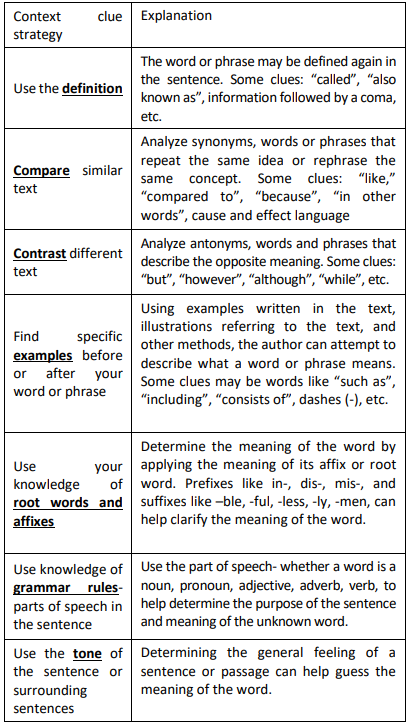
Model teaching. Reading Comprehension Strategy Tools. Model teaching, 2016. Disponível em: https://www.modelteaching.com/education-articles/reading-ela-instruction/reading
comprehension-strategy-tools. Acesso em: 12 jul. 2024. Adaptado.
Em uma atividade de leitura do texto “Bigger Isn’t Always Better: Narrow Traffic Lanes Make Cities Safer”, os alunos tiveram dificuldade de interpretação do último período por não saberem o sentido do termo ‘narrower’. Sobre isso, analise as estratégias:
I. Procurar a definição do termo em um dicionário inglês-português.
II. Procurar por dicas na imagem que acompanha o artigo.
III. Identificar o sentido dos termos ‘bigger’ e ‘wider’.
IV. Identificar a classe gramatical do termo e o sentido do sufixo -er.
Com base na tabela fornecida, para que os alunos possam entender o sentido do termo (‘narrower’) pelo contexto, o professor deve orientar que eles adotem as seguintes estratégias:

I, III e IV, apenas.
II, III e IV, apenas.
I, II e IV, apenas.
II e III, apenas.
I, II, III e IV.

