



Questões de Concurso sobre Língua Inglesa e Educação - Página 159 | Gran Questões

Questões de Concurso sobre Língua Inglesa e Educação


Disciplina 1
Assunto 1
Banca
Instituição
Cargo
Ano
Carreira
Área de formação
Escolaridade
Dificuldade
 
Comentários:
Professores
Alunos
Meus Comentários
Vídeo
 
Minhas questões:
Resolvidas
Não resolvidas
Certas
Erradas
 
Tipo de questão:
Certo e errado
Múltipla escolha
Incluir questões:
Anuladas
Desatualizadas
 
Questões:
Todas as questões
 
Filtro simplificado
 
Questões
Todas as questões
 
2.494 questões encontradas
Questões por página
20
Mais recentes
 

The method which stresses interaction to teach a second language effectively is:


A

CLT - Communicative Language Teaching


B

EST - English for Science and Technology


C

ESP - English for Specific Purposes


D

EGP - English for General Purposes

Which are the abilities of English communication?


A

Reading, writing, speaking and listening.


B

Speaking, reading, writing, linguistic knowledge and intercultural dimension.


C

ASL, linguistic knowledge and intercultural dimension.


D

Speaking, reading and writing.


E

All answers are incorrect.

Identifique abaixo as afirmativas verdadeiras ( V ) e as falsas ( F ) a respeito da compreensão auditiva e escrita em Língua Inglesa.

( ) A compreensão da escrita em língua inglesa tem como objetivos a aquisição de conhecimento e de informação.

( ) As atividades de leitura, assim como as de compreensão oral, baseiam-se em conceitos de aquisição contextualizada de situações cotidianas em língua inglesa, que serão exploradas somente em sala de aula pelo professor.

( ) A compreensão auditiva tem como objetivo a aquisição de conhecimento, de informação e da fruição em língua inglesa, com o propósito de motivar, despertar o interesse e dar segurança ao aluno.

( ) O papel do professor, na atividade de compreensão auditiva, é o de estimular o aluno a executar tarefas de audição passiva.

Assinale a alternativa que indica a sequência correta, de cima para baixo.


A

V • V • V • F


B

V • F • V • F


C

V • F • F • V


D

F • F • V • V


E

F • F • V • F

Em relação a avaliação, o PCN – Língua Estrangeira diz que é parte integrante e intrínseca ao processo educacional, indo muito além da visão tradicional, que focaliza o controle externo do aluno por meio de notas e conceitos. A função da avaliação é alimentar, sustentar e orientar a ação pedagógica e não apenas constatar um certo nível do aluno.


Analise os itens abaixo:


I. A avaliação não deve ser confundida com testes, tão frequentes na avaliação de Língua Estrangeira. Estes são instrumentos, meios para um fim.

II. Os testes, ou provas, constituem meios de se avaliar um aspecto apenas do processo de aprendizagem, ou seja, o produto em relação ao desempenho, tendo em vista determinados conteúdos ou objetivos, em termos de progresso ou de proficiência. Não podem jamais constituir-se em instrumentos de ameaça ou intimidação, para mostrar apenas o que o aluno não sabe, situando-se acima de suas possibilidades.

III. É necessário enfatizar a diferença entre avaliar a capacidade de desempenho do aluno e estabelecer diferentes níveis de proficiência.

IV. Em uma avaliação formativa interativa há procedimentos constantes e personalizados envolvendo professor e alunos, a partir de critérios não apenas normativos, mas principalmente pessoais, que irão envolver, da parte do professor, uma reflexão sobre si mesmo (sua autoavaliação) e sobre os alunos, e, da parte dos alunos, uma autoavaliação e uma avaliação do professor.


Marque a alternativa CORRETA:


A

Todos os itens estão corretos


B

Apenas os itens I e IV estão corretos


C

Apenas os itens II e III estão corretos


D

Apenas os itens II e IV estão corretos


E

Apenas os itens I, III e IV estão corretos

O ensino de língua inglesa, partindo dos gêneros discursivos, tem como objetivo buscar alternativas de ensino da língua inglesa, de forma a minimizar as dificuldades de aprendizagem e oportunizar aos estudantes uma forma atraente e objetiva de aprender uma segunda língua.

Identifique abaixo as afirmativas verdadeiras ( V ) e as falsas ( F ) sobre o tema citado.

( ) Gêneros discursivos são ambientes de aprendizagem, onde se pode construir sentido.

( ) Trabalhar com gêneros discursivos possibilita ao uso do idioma inglês em práticas comunicativas.

( ) A escolha de um único gênero discursivo possibilita ao estudante participar na vida social de sua escola.

( ) Os gêneros textuais podem ser orais e escritos, desde que os estudantes consigam reconhecê-los, e se tornem objeto de estudo no processo de ler.

Assinale a alternativa que indica a sequência correta, de cima para baixo.


A

V • V • F • V


B

V • V • F • F


C

V • F • F • V


D

F • V • F • V


E

F • F • V • V

Assinale a alternativa cuja caracterização de estratégias de leitura esteja INCORRETA.


A

Skimming consists of quickly grasping the gist of a text.


B

Scanning is characterized by locating specific information within the text.


C

Contextual guessing refers to inferring the meaning of unknown words by context.


D

Note-taking means only taking notes of main ideas.


E

Predicting means building expectations of text ideas before reading a text per se.

The method that is also recognized as the Army Method, used during the first world war, because the American Armed forces started escalating oral courses known as the Military particular Training Program (ASTP) which focuses on communication, is:


A

The Direct Method.


B

Suggestopedia Method.


C

Community Language Learning Method.


D

Task-Based Learning Method.


E

The audio-lingual Method.

Consider the following situation: you are discussing the topic ‘Work’ with your English language students and now you are going to read a magazine article about a type of job interview called ‘extreme interviews’. The heading of the article is: Extreme interviews: what kind of dinosaur are you? If you answered Tyrannosaurus rex, then the bad news is that you probably won’t get the job you’re applying for.


The tasks below are adapted versions of the activities, from the textbook, to work with the text. Match Tasks 1 – 6 with their main aim A – I. There are three extra aims which you do not need to use.


Tasks


Task 1


Discuss the questions in small groups.


1 Have you ever been to a job interview? How was the experience? What kind of questions did they ask you? Did you get the job?

2 What kind of questions do you expect to have in a job interview?

3 How can people get better prepared for a job interview?


Task 2


Look at the photo with the article. What do you think is happening? Do you think the question is one that someone might really ask in this situation? Why (not)?
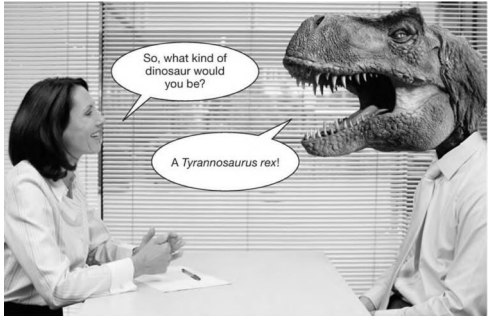

Imagem associada para resolução da questão


Task 3


Read the article once and find out. How would you answer the question?


Task 4


Look at the highlighted words and phrases in the text. With a partner, try to figure out what they might mean and how you think they are pronounced.


Task 5


Read the article again. Using your own words, answer the questions.


1 What are extreme interviews?

2 What kind of companies first started using them?

3 Why do some people think that they are better than normal interviews?


Task 6


Do you think extreme interviews are a good way of choosing candidates? Which of the questions below (used in real interviews) do you think would work well? Why?
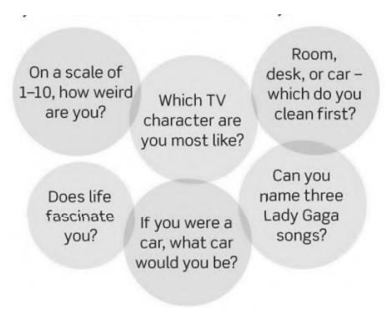

Imagem associada para resolução da questão


Adapted from: Face2Face Intermediate. Cris Redston and Gillie Cunningham. Cambridge University Press.


Main Aim


A. Integrating skills and personalizing the topic.

B. Analyzing text organization.

C. Inferring meaning of lexis from context.

D. Predicting.

E. Teaching grammar inductively using the text.

F. Skimming.

G. Activating schemata.

H. Reading for details.

I. Scanning.


A

Task 1-G; Task 2-D; Task 3-F; Task 4-C; Task 5-H; Task 6-A.


B

Task 1-F; Task 2-G; Task 3-D; Task 4-E; Task 5-B; Task 6-C.


C

Task 1-F; Task 2-D; Task 3-I; Task 4-G; Task 5-B; Task 6-H.


D

Task 1-G; Task 2-I; Task 3-D; Task 4-B; Task 5-F; Task 6-A.


E

Task 1-D; Task 2-A; Task 3-F; Task 4-C; Task 5-H; Task 6-G.

Foreign Language Teaching Method is the specific way in which something is taught. Different teachers may use different teaching methods, depending on their teaching philosophy to describe the way in which they teach. Content and Language Integrated Learning (CLIL methodology), is used to teach students about a new subject in a language foreign to them.

Analyze the statements below regarding the subject.

1. Students are also focused on a subject that interests them and the fact that acquiring more linguistic knowledge will help them learn the target matter better is very motivating.

2. Students learn the language through grammar rules and, the success of this method relies on the integration of the grammar and the learning content.

3. Students learn the language naturally, through conversation, observation and socializing, where learning grammar is not the primary goal.

Mark the option that indicates all the correct statements.


A

Only statement 2 is correct.


B

Only statement 3 is correct.


C

Statements 1 and 2 are correct.


D

Statements 1 and 3 are correct.


E

Statements 2 and 3 are correct.

 
Ir para a página:
OK
 
Gerar simulado