





Seu próximo nível começa aqui
Com a Assinatura Ilimitada, você tem tudo que precisa para sua aprovação.
Com a Assinatura Ilimitada, você combina prática, teoria e método em uma única assinatura com tudo que você precisa para sua aprovação.
When the adopted methodology for teaching English focuses only on the apparent reasons for the student's interest in learning English, the commonest one is:
ESP - English for Specific Purposes
EAP - English for Academic Purposes
EST - English for Science and Technology
EGP - English for General Purposes
When discussing the typical sequence of an English language lesson, Scrivener (2011), proposes the following diagram:
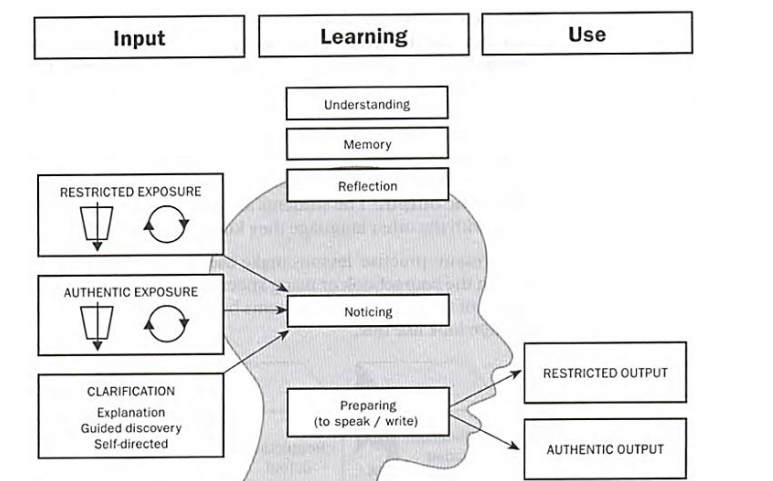
Source: Scrivener (2011, p. 159).
You, as an English language teacher, establishes that your group’s following communicative objective is to make predictions about the future. In order to achieve that, you decide to work with the article Bing A.I. and the Dawn of the Post-Search Internet to develop reading skills and also to work with the structure Future Simple with Will to make future predictions. Considering this classroom situation and Scrivener’s diagram, analyze the following statements.
I. The article functions as input material, once students are exposed to the target language, in this case, will for future predictions.
II. The teacher draws students’ attention to part of the text and asks students to find one prediction the author is making about the future. Students identify it. This step of the lesson is what Scrivener calls self-directed clarification in his diagram, once students work completely autonomously, without the teacher’s intervention.
III. The teacher draws students’ attention to other two model sentences of future prediction from the text. Then, the teacher asks questions such as Are we talking about a present, past or future situation?; How do you know it’s future?; So when we want to make a prediction about the future, what do we use?. This is what Scrivener calls, in his diagram, guided-discovery clarification and the questions used by the teacher are called concept-checking questions.
IV. The teacher carries out some drilling exercises to systematize the target language. Then, the teacher asks students to produce an infographic making predictions for the future. The first practice, the drilling exercises, is what Scrivener calls in his diagram authentic output, or freer practice, while the infographic is what he calls restricted output, or controlled practice.
It is completely accurate what is stated in
II, III and IV only.
I, II and III only.
I and IV only.
II and IV only.
I and III only.
Leia o texto sobre a concepção de ensino da língua inglesa apresentada pela BNCC e analise a charge a seguir:
“(...) a língua inglesa não é mais aquela do ‘estrangeiro’, oriundo de países hegemônicos, cujos falantes servem de modelo a ser seguido, nem tampouco trata-se de uma variante da língua inglesa. Nessa perspectiva, são acolhidos e legitimados os usos que dela fazem falantes espalhados no mundo inteiro, com diferentes repertórios linguísticos e culturais, o que possibilita, por exemplo, questionar a visão de que o único inglês ‘correto’ – e a ser ensinado – é aquele falado por estadunidenses ou britânicos” (Fonte: basenacionalcomum.mec.gov.br).
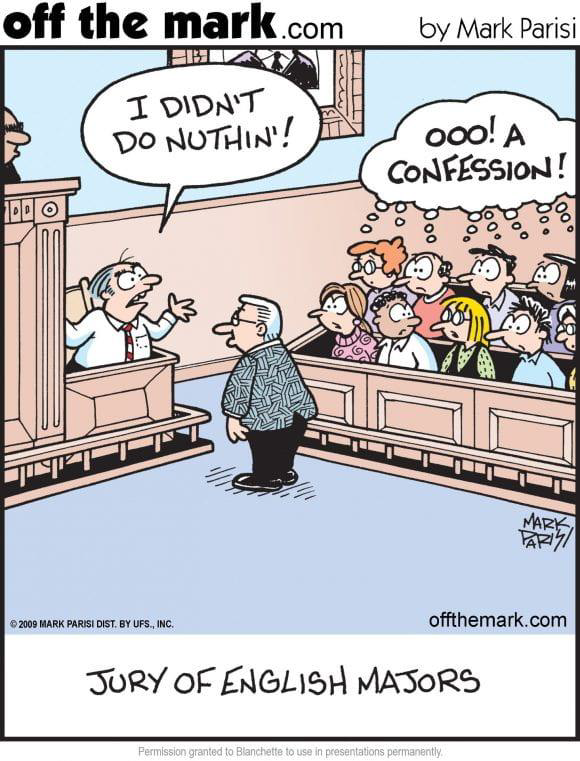
Fonte: sites.psu.edu
Analise as seguintes asserções e a relação proposta entre elas:
I. Tanto a BNCC quanto a charge apresentam a mesma concepção de erro.
POIS
II. Ambas condenam o uso de repertório linguístico inadequado.
A respeito dessas asserções, assinale a alternativa correta.

As asserções I e II são verdadeiras, e a II é uma explicação correta da I.
As asserções I e II são verdadeiras, mas a II não é uma explicação correta da I.
A asserção I é uma proposição verdadeira, e a II é uma proposição falsa.
A asserção I é uma proposição falsa, e a II é uma proposição verdadeira.
As asserções I e II são proposições falsas.
São considerados traços distintivos para o ensino de Inglês Instrumental, EXCETO:
O domínio de vocabulário técnico para o mundo de negócios.
A análise das necessidades específicas do estudante.
Os objetivos de aprendizagem claramente definidos.
O conteúdo específico para alcançar os objetivos do estudante.
As habilidades necessárias para que se alcancem os objetivos propostos.
It has been argued that “Fostering a critical stance in very young readers can have surprising results, for both children and teachers” (BOURKE, Ryan T. First Graders and Fairy Tales: One Teacher's Action Research of Critical Literacy. The Reading Teacher 62 (4), 2008, 304-312, p. 304).
This quotation is in line with the following goals for the teaching of English defined by the Municipal Secretariat of Education, São Paulo (2019), except:
Preparing a play based on a story told in class and performing it.
Rewriting the beginning and the end of a narrative as group work.
Learning about a narrative by following the oral reading and discussing it.
Working in a group, inferring information and relationships that are not explicit in the text.
Collecting information on the schedules, eating habits, leisure activities and daily routines of the group.
The BNCC document formulates that the teaching of English in schools should consider the status of the language as a lingua franca. This means that, in teaching-learning contexts,
precedence should be given to the development of oral skills, considering conversation is the primary goal.
errors should be left uncorrected so as not to interfere with students’ motivation to learn.
“correct English” must be emphasized, as it contributes to more fluent communication between speakers.
all language varieties may be used, but preference is to be given to non-native models of the English language.
intelligibility is more relevant than the achievement of native-like pronunciation.
O texto abaixo refere-se a que tipo de abordagem no ensino de línguas?
Há um maior entendimento de que a língua consiste em léxicos gramaticais. A evidência da linguagem do computador e da análise do discurso influenciam o planejamento do conteúdo do curso; é reconhecida a supremacia da oralidade à escrita; os erros são reconhecidos como processo da aprendizagem; a tarefa e o processo são mais importantes do que o exercício e o produto da língua.
Método psicolinguístico
Abordagem lexical
Abordagem comunicativa
Abordagem da compreensão
A aquisição da língua é vista como aquisição de regras, não como formação de hábito; os alunos são responsáveis por seu aprendizado; a perfeição na pronúncia é vista como irreal; a linguagem escrita (reading/writing) é tão importante quando a oral (listening/speaking); os professores devem ter boa proficiência geral na língua. A que abordagem se refere o texto?
Abordagem cognitiva
Abordagem da compreensão
Abordagem comunicativa
Abordagem humanista
Type of assessment that aims to identify the reality of knowledge of each student and verify their abilities or learning difficulties. Usually this modality is applied in the initial and final moments of a phase of education. The purpose of this assessment is to get to know the students better, identifying and understanding their needs. The information obtained through this type of evaluation highlights the strengths and weaknesses of the educational process.
Diagnostics.
Formative.
Comparative.
Arithmetic.
Considerando a Base Nacional Comum Curricular de Língua Inglesa (BNCC), julgue as sentenças abaixo como VERDADEIRAS ou FALSAS:
1.(__)O estudo do léxico e da gramática, envolvendo formas e tempos verbais, estruturas frasais e conectores discursivos, entre outros, tem como foco levar os alunos, de modo indutivo, a descobrir o funcionamento sistêmico do inglês.
2.(__)A prática da escrita proporciona o desenvolvimento de uma série de comportamentos e atitudes − como arriscar-se e se fazer compreender, dar voz e vez ao outro, entender e acolher a perspectiva do outro, superar mal-entendidos e lidar com a insegurança.
3.(__)O ato de escrever é concebido como prática social e reitera a finalidade da escrita condizente com essa prática, oportunizando aos alunos agir com protagonismo.
A sequência CORRETA é:
1.V, 2.V, 3.V.
1.F, 2.V, 3.F.
1.F, 2.V, 3.V.
1.V, 2.F, 3.V.
1.V, 2.F, 3.F.


