




Seu próximo nível começa aqui
Com a Assinatura Ilimitada, você tem tudo que precisa para sua aprovação.
Com a Assinatura Ilimitada, você combina prática, teoria e método em uma única assinatura com tudo que você precisa para sua aprovação.
“If generative AI systems ______ implemented across public education systems without a concomitant expansion of teacher training frameworks and regulatory safeguards, the resulting asymmetries in access and digital literacy may well intensify pre-existing structural inequities rather than mitigate them.” (Excerpt adapted from: UNESCO [2023]. “Guidance for Generative AI in Education and Research”)
The conditional construction that most appropriately conveys formal contingency in institutional discourse is:
were
‘d be
are to be
would be
When the sentence ‘If you say something in English and then in another language, your child will automatically listen for their stronger language and ‘tune out’ the other language.’ is changed to the second conditional, it becomes:
If you said something in English and then in another language, your child would automatically listen for their stronger language and ‘tune out’ the other language.
If you say something in English and then in another language, your child would automatically listen for their stronger language and ‘tune out’ the other language.
If you said something in English and then in another language, your child will automatically listen for their stronger language and ‘tune out’ the other language.
If you had said something in English and then in another language, your child would automatically listen for their stronger language and ‘tune out’ the other language.
If you say something in English and then in another language, your child would automatically had listened for their stronger language and ‘tune out’ the other language.
Examine this sentence from the article: "Even if effective, these changes will take some time to work through and may not be enough to convince voters that Labour is on their side − particularly if inflation is not brought under control." This sentence contains two conditional structures. The phrase "Even if effective" represents a concessive conditional (acknowledging a possibility while suggesting it may not change the outcome), while "if inflation is not brought under control" is a first conditional (real possibility in the future). Understanding conditional structures is essential for both comprehension and production in English. Which of the following statements correctly analyzes the conditional structures and their functions in academic and journalistic English?
The structure "even if effective" is an elliptical conditional (with "these changes are" implied), while "if inflation is not brought under control" is a complete first conditional clause; both are grammatically correct and commonly used in formal written English.
The first conditional "even if effective" is incorrectly formed and should be "even if it will be effective" to maintain grammatical consistency with the future tense in the main clause.
Both conditional clauses express impossible or hypothetical past situations, requiring the past perfect tense in standard formal English, which makes the sentence grammatically incorrect as written.
The passive voice "is not brought under control" is always grammatically incorrect in conditional clauses and should be replaced with an active construction in all contexts.
In the sentence, "Although it was raining, we decided to go for a walk," identify the type of clause underlined: "Although it was raining".
Simple Sentence.
Main Clause.
Independent Clause.
Dependent (Subordinate) Clause.
In the extract from the fourth paragraph “E-communication is a form of writing that resembles casual conversation”, the bolded part is being used as
an adjective phrase.
a noun phrase.
a noun clause.
an adjective clause.
an adverb clause.
Which of the following sentences is an example of the first conditional?
If I had known about the meeting, I would have attended.
If she studies hard, she will pass the exam with flying colors.
If I had his number, I would call him
If I had enough time, I would travel the world.
Read the sentences below.
Each item presents one type of conditional followed by an example.
Identify which conditionals are grammatically correct and logically coherent.
I.First Conditional: If it rains tomorrow, we will stay at home.
II.Second Conditional: If I will study harder, I would pass the exam.
III.Third Conditional: If she had known about the meeting, she would have come earlier.
It is correct what is stated in:
I and II, only.
III, only.
II, only.
I, II and III.
I and III, only.
Which sentence avoids a comma splice and uses the linker appropriately to join two independent clauses?
Researchers mapped the dialect therefore the sample was small.
Although researchers mapped the dialect, but the sample was small.
Researchers mapped the dialect; however, the sample was small.
Researchers mapped the dialect, however the sample was small.
Researchers mapped the dialect, and however the sample was small.
Which of the following sentences correctly uses the third conditional?
If she had studied harder, she would pass the exam.
If she studied harder, she would have passed the exam.
If she had studied harder, she would have passed the exam.
If she would study harder, she would had passed the exam.
If she has had studied harder, she would had passed the exam.
Choose the sentence with the correct conditional structure:
If I will study, I would pass the test.
If she had known, she would have told us.
If he calls, we will left the meeting.
If you studied, you pass the exam.
Analyze:
“The cake could be better if she followed the recipe.”
Select the option that correctly classifies the sentence above:
Zero Conditional;
First Conditional;
Second Conditional;
Third Conditional.
In the sentence from the second paragraph “If the concept of method authorizes theorizers to centralize pedagogic decision-making, the postmethod condition enables practitioners to generate location-specific, classroom-oriented innovative strategies”, the conditional clause can be correctly rewritten as:
Should the concept of method authorize theorizers to centralize pedagogic decision-making...
Were the concept of method to authorize theorizers to centralize pedagogic decision-making…
However the concept of method should authorize theorizers to centralize pedagogic decision-making…
Had the concept of method authorized theorizers to centralize pedagogic decision-making…
While the concept of method authorizes theorizers to centralize pedagogic decision-making…
In the extract from the text “the concept of task as the location for learning a foreign language (FL), a space for creation in and with the target language, with the tasks utilized simulating as closely as possible the situations which the students will encounter outside the classroom”, the word in bold introduces a clause that modifies
the tasks utilized.
space for creation.
the situations.
a foreign language.
the concept of task.
The author of the article states that access to Pheasant Island is usually forbidden. Considering that, analyze the second conditional statement below in standard English:
“If the island ______ open to the public year-round, it _____ lose its unique appeal”.
Mark the alternative that fills in, correctly and respectively, the blanks in the sentence above.
was - will
were - would
is - would
were - will
was - would
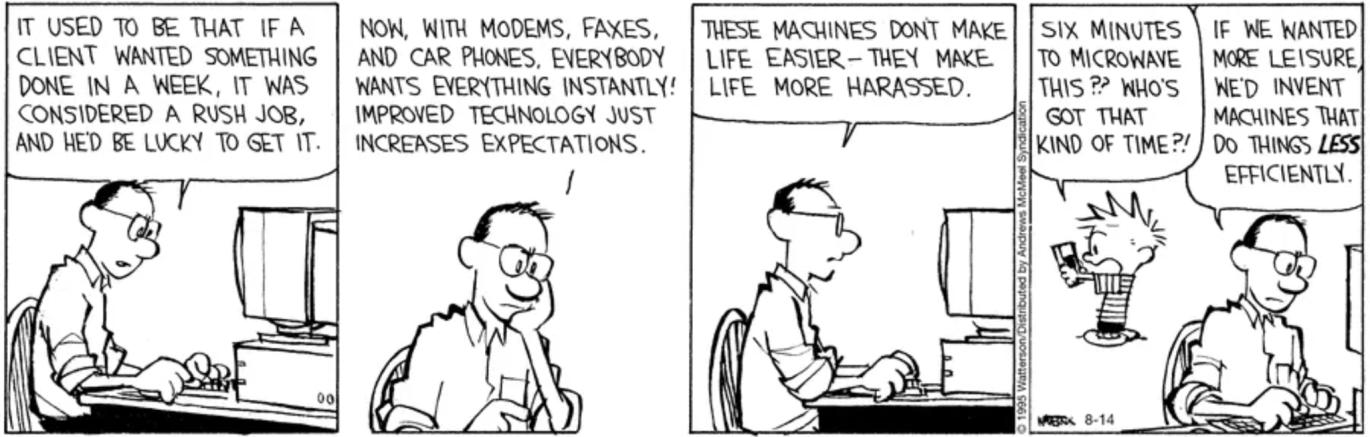
Watterson, Bill. “Calvin and Hobbes.” GoComics. https://www.gocomics.com/calvinandhobbes/2025/08/14. Accessed August 17, 2025.
In “If we wanted more leisure, we’d invent machines that do things less efficiently,” which conditional structure is used?
Zero conditional
First conditional
Third conditional
Second conditional
Mixed conditional
In the sentence, “Had I known you were coming, I would have baked a cake,” which feature of conditional sentences is being demonstrated?
A regular third conditional sentence.
A mixed conditional sentence
An inverted conditional sentence
A second conditional with a modal verb
A past unreal conditional
Conditional sentences describe a condition and its result. The First Conditional is used for real or possible situations in the future. Select the correct structure for the First Conditional.
If + Past Simple, ... would + infinitive (e.g., "If it rained, I would stay home").
If + Past Perfect, ... would have + past participle (e.g., "If it had rained, I would have stayed home").
If + Present Simple, ... would + infinitive (e.g., "If it rains, I would stay home").
If + Future with will, ... will + infinitive (e.g., "If it will rain, I will stay home").
If + Present Simple, ... will + infinitive (e.g., "If it rains, I will stay home").
(PMM/URCA 2025) The clause “beauty and youth are fleeting” functions as:
The subject of the main clause.
The object of the main clause.
The main clause itself.
A dependent clause.
An adverbial clause.
The first conditional is used to express the consequence of a realistic possibility now or in the future. Which item below displays that?
If I won a lot of money, I'd buy a big house in the country.
I can't sleep at night if I drink too much coffee.
If it doesn't rain tomorrow, we'll go to the beach.
If I were you, I wouldn't bother her.
The clause “although intense” is a full subordinate clause, with explicit subject and predicate.
Certo
Errado